
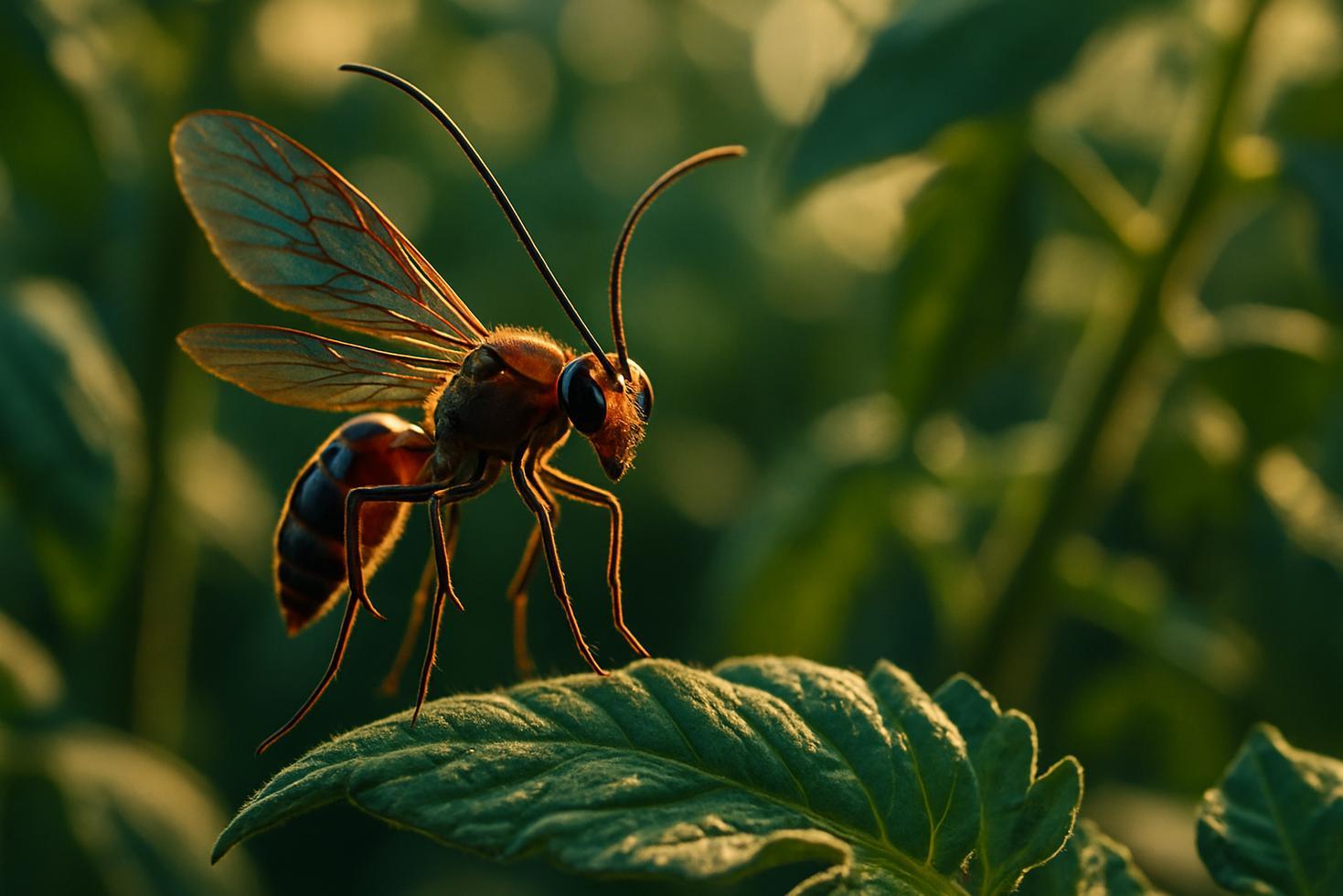
A single sublethal dose can cut a parasitoid wasp’s host-finding ability by 25–80% — the insect keeps flying, but the pest population it once held in check stops being controlled.
Pesticides can dismantle biological pest control without killing a single beneficial insect outright. In laboratory and semi-field studies, doses too small to cause death still scrambled the olfactory signals that parasitoid wasps rely on to locate hosts and find mates — leaving the wasp alive but functionally useless as a pest suppressor.
The mechanism is chemical interference with sensory hardware. In Nasonia vitripennis, a dose as small as 0.63 ng of acetamiprid disrupted pheromone response in females, and 0.105 ng of dimethoate produced the same effect. These are field-realistic concentrations. The wasp isn’t visibly affected — it just stops tracking.
How Sublethal Pesticide Doses Impair Olfaction and Mating in Parasitoid Wasps
The damage runs deeper than a single missed host. Transcriptome analysis of imidacloprid-exposed parasitoids found downregulated chemoreception genes — the underlying molecular machinery for smell and host recognition degraded at the gene-expression level.
In Nasonia vitripennis studies, impaired olfactory host-finding began at ≥1.05 ng acetamiprid — disrupting both host-seeking in females and courtship behavior in males. A wasp that cannot respond to mating signals does not reproduce. A female avoiding host odor entirely — which occurred at doses ≥0.21 ng dimethoate — simply stops contributing to pest suppression.
What Spinosad and Other Pesticides Do to Adult Parasitoid Wasps on Contact
Not all effects are sublethal. Spinosad caused 100% mortality in exposed adult parasitoids in one study, with 80% mortality in pupae. Fresh residues of deltamethrin and azadirachtin were also harmful under semi-field conditions — classified as moderately to severely harmful within 72 hours of application.
Residue age matters. Fifteen-day-old residues became harmless for most compounds tested, except deltamethrin, which remained harmful. This means the timing of a spray relative to wasp activity determines much of the biological damage.
Quick Answer
- Doses as low as 0.63 ng acetamiprid disrupted pheromone response in Nasonia vitripennis females.
- Spinosad caused 100% mortality in exposed adult parasitoids; sublethal doses of other pesticides cut longevity, fertility, and biocontrol activity by 25–80%.
- Imidacloprid downregulates chemoreception genes, impairing both host-seeking and courtship behavior.
- 54% of herbicides are reported harmful or moderately harmful to parasitic wasps in one review.
- Fresh residues are most dangerous; 15-day-old residues of most tested pesticides became harmless except deltamethrin.
The pest population doesn’t wait. Once the wasp stops locating hosts — whether killed outright or sensory-impaired — top-down pressure on tomato pests disappears. The rebound isn’t dramatic. It’s a quiet arithmetic: fewer parasitized hosts, more surviving larvae, faster population growth.
That’s the part sublethal effects make easy to miss. No dead wasps on the ground, no obvious spray damage. Just a biological control system running at a fraction of its former capacity, and a pest problem that keeps returning without an obvious cause.
Frequently Asked Questions
Can a parasitoid wasp recover from sublethal pesticide exposure?
Current research documents the behavioral and reproductive impairments but does not establish full recovery. Residue-based effects diminished over 15 days for most compounds, but gene-expression-level disruption from imidacloprid was linked to lasting chemosensory deficits.
Which pesticides are most harmful to parasitoid wasps?
Spinosad caused 100% adult mortality on contact. Deltamethrin residues remained harmful at 15 days. Acetamiprid and dimethoate impaired olfaction at nanogram-scale sublethal doses.
Do herbicides also harm parasitoid wasps?
One review found 54% of herbicides are harmful or moderately harmful to parasitic wasps and other beneficial arthropods.
What tomato pests do parasitoid wasps normally suppress?
The reviewed studies focused on parasitoids of caterpillar pests and aphids in vegetable systems. When wasp effectiveness drops, those host pest populations face reduced biological pressure and can rebound.