
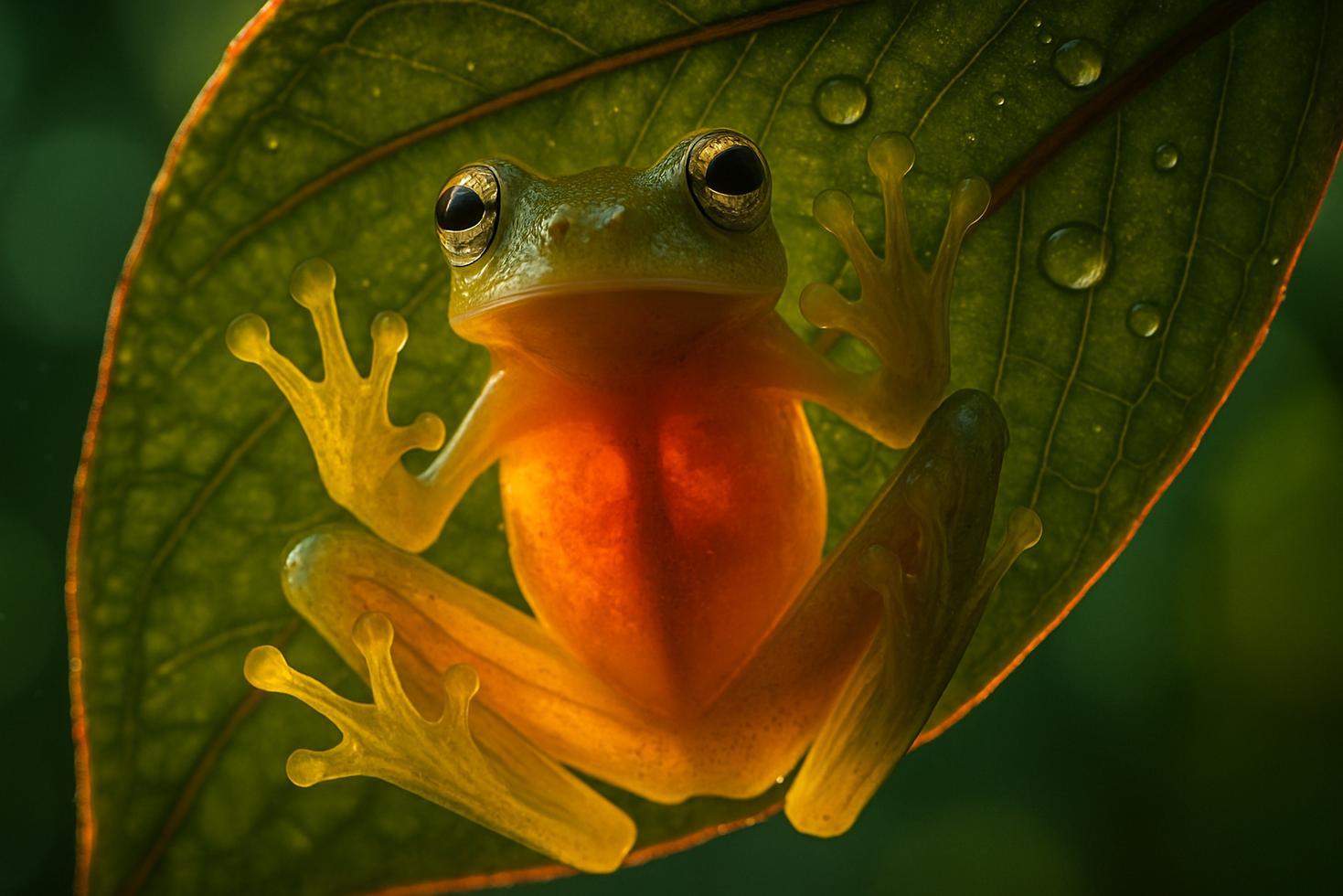
Glass frogs pull ~89% of their red blood cells into the liver during sleep — the liver swells 40% larger to hold them — and the frog turns 2–3× more transparent in the process.
Glass frogs achieve near-invisibility by actively removing about 89% of their circulating red blood cells from the bloodstream and packing them into the liver during rest. That is not a passive feature of their skin. It is a daily physiological operation, confirmed in a December 2022 study published in Science using photoacoustic imaging.
The result is a two- to threefold increase in transparency. The frog’s translucent skin and muscles are only part of the picture. The liver does the heavy lifting — literally expanding by about 40% to accommodate the concentrated cells.
Quick facts:
– ~89% of circulating red blood cells are removed from the bloodstream during rest
– Transparency increases 2–3× compared to active frogs
– The liver enlarges by about 40% to store the sequestered cells
– Cells reaggregate in the liver within roughly an hour after movement begins
– The mechanism is a reversible daily redistribution, not cell destruction
How Glass Frogs Sequester Red Blood Cells Without Clotting
The 2022 Science study found that glass frogs concentrate nearly their entire supply of red blood cells into an extremely small volume — without triggering clotting. That is unusual for vertebrates. Packing that density of cells in any other context would normally cause the blood to coagulate.
Reflective guanine crystals in the liver appear to conceal the stored cells from view. The crystals make the liver surface mirror-like, helping the organ blend visually against a leaf even as it holds a massive load of pigmented cells.
Why Glass Frog Camouflage Works Best During Daytime Rest
Glass frogs are nocturnal. They feed and mate at night, when darkness already provides cover. During the day, resting motionless on a leaf, they are at their most vulnerable to predators. That is precisely when the sequestration mechanism is fully active and transparency peaks.
When darkness arrives and the frog becomes active, the stored cells are released back into circulation within roughly an hour. The switch is fast. A resting, near-invisible frog becomes a fully circulating, pigmented animal on a timeline measured in minutes, not hours.
The camouflage is not about color or pattern. It runs at the level of blood chemistry, reversed twice every day.
Most animals hide using what is already on the outside. Glass frogs restructure what is inside. The liver — typically invisible in any conversation about animal camouflage — turns out to be the mechanism that makes the whole system work.
Frequently Asked Questions
How transparent do glass frogs get?
Resting glass frogs increase their transparency two- to threefold compared to active frogs, according to the 2022 Science study.
What happens to the red blood cells when a glass frog sleeps?
About 89% of circulating red blood cells are removed from the bloodstream and stored in the liver, which enlarges by about 40% to hold them.
How long does it take for the glass frog’s blood to return to normal?
Red blood cells reaggregate in the liver within roughly an hour after the frog begins moving, with circulation restoring as activity increases.
Why don’t glass frogs clot when blood concentrates in the liver?
Researchers have noted that the dense packing occurs without apparent clotting, which is unusual for vertebrates — the exact mechanism preventing coagulation remains an active area of inquiry.