
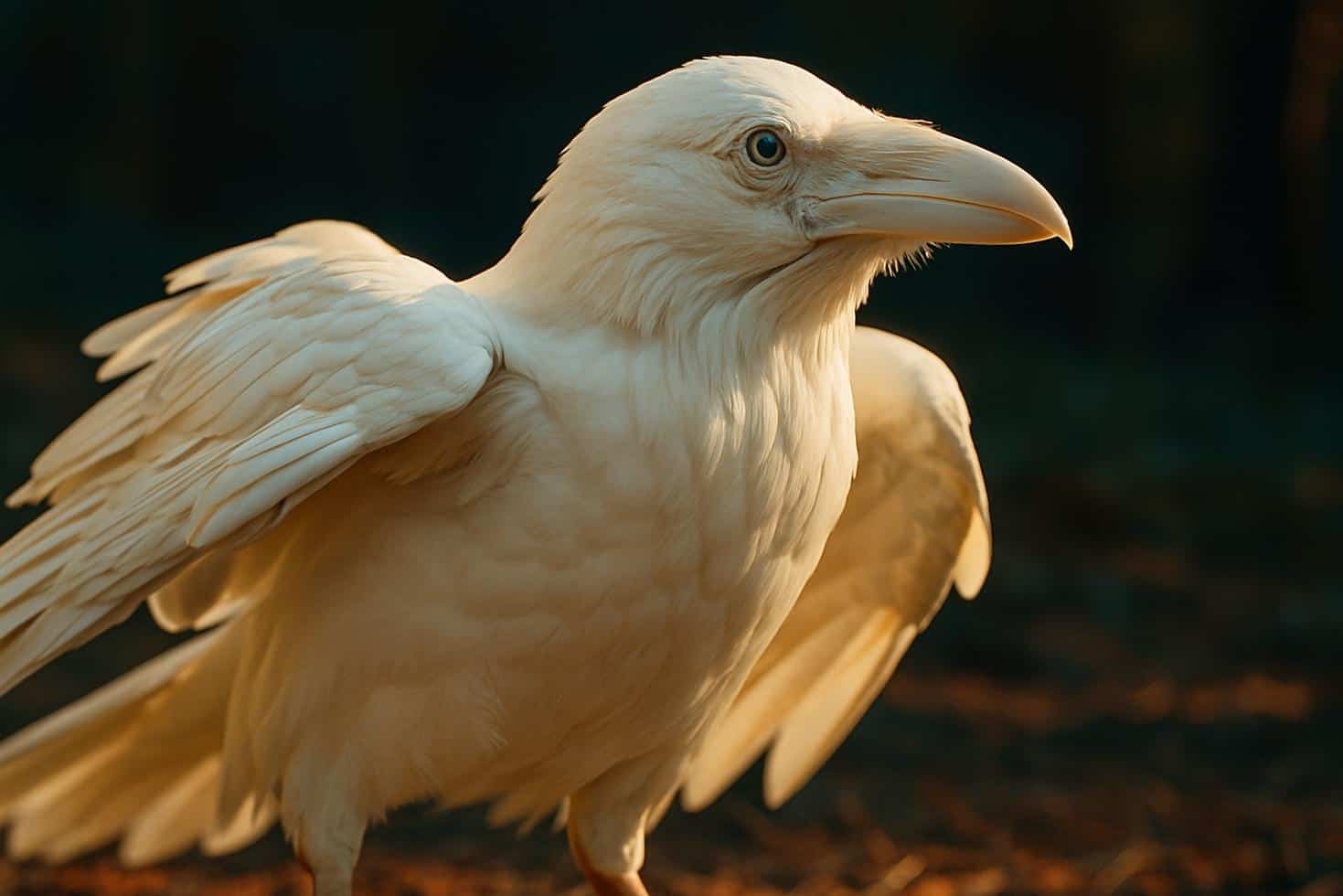
A raven has a 1-in-30,000 chance of hatching white — same species, same behavior, but the flock reads it as a stranger it cannot place.
A white raven is not a separate species. It is a common raven (Corvus corax) whose pigment-producing cells failed to activate, leaving the bird cream-colored with blue eyes in a world built on individual recognition. That single biological difference cascades into something much harder to watch.
Ravens remember individuals. They track alliances across years and hold grudges across encounters. When a white bird arrives wearing familiar raven behavior, the flock’s recognition system finds no match — and the social consequences follow from that mismatch, not from cruelty.
Leucism vs. Albinism: What Actually Differs in the White Raven’s Biology
Albinism is a failure of the enzyme that produces melanin. Leucism is different — the enzyme is present, but the cells meant to deploy pigment never developed or never fired. Pigment-producing cells absent rather than broken is the distinction that matters here. The result is a bird that loses multiple pigment types, not just melanin, which is why the eyes hold their blue color rather than the pink or red visible in true albinos.
How Raven Social Structure Turns Color Loss into Survival Risk
Ravens are among the few non-human animals documented to track individual identities, remember past interactions, and adjust alliances accordingly. A white bird does not smell wrong. It does not call wrong. It simply presents a visual signature that matches no stored identity in a brain wired to catalog thousands of individual markings. White ravens on Vancouver Island have been observed struggling to survive winter months, with CBC reporting poor overwintering outcomes — though no precise survival rate has been confirmed. The social exclusion is a consequence of a recognition system that cannot process an unfamiliar appearance, not a deliberate group decision.
Rarity by the Numbers: How Few White Ravens Actually Exist
The 1-in-30,000 figure from the U.S. Fish and Wildlife Service applies to leucistic birds broadly. In Anchorage, Alaska Public Media documented only three white raven sightings over approximately 40 years — a city with a substantial raven population. Vancouver Island represents the most consistent cluster of reported sightings over the past two decades, making it the best-documented location for observing white ravens in the wild.
The genetics follow a simple recessive pattern. Two carrier parents, each visually black, produce white offspring at a 25% rate per egg. Half of their offspring will be black carriers, passing the gene forward invisibly.
The bird is not broken. It is simply unreadable to the one community that could have kept it alive — and that gap, built from a single genetic switch, is enough.
Frequently Asked Questions
What causes a raven to be born white?
Leucism — a condition where pigment-producing cells are absent or nonfunctional — causes the white coloration. It is not albinism, which involves a missing melanin enzyme.
Do white ravens have pink eyes?
No. White ravens have blue eyes, which is a key indicator distinguishing leucism from albinism.
How rare is a white raven?
The U.S. Fish and Wildlife Service estimates 1 in 30,000 birds is born leucistic. Only three have been documented in Anchorage over roughly 40 years.
Can two black ravens produce a white offspring?
Yes. If both parents carry the recessive leucistic gene, each egg has a 25% chance of producing a white bird.