

Peony Types: What They Actually Look Like In The Garden
Peony bloom form predicts garden behavior better than any variety name. Four structural types cover nearly every peony sold today.
Single peonies have one ring of petals around visible stamens. This is the lightest bloom form. It stays upright without staking and holds up best against rain and wind.
Japanese and anemone (semidouble) types have a full outer petal ring with narrow petaloids replacing the stamens. This form is lighter than a full double. It is nearly as weather-resistant, too.
Full double peonies are the dense cabbage bloom most people picture. They put on the biggest show and carry the strongest fragrance. The extra petal weight can make doubles flop, so they often need a peony ring after hard rain.
Tree peonies (Paeonia suffruticosa and hybrids) are woody shrubs that do not die back each winter like herbaceous peonies. They bloom earlier and produce larger flowers. Tree peonies also need more winter protection.
Itoh (intersectional) hybrids cross herbaceous and tree peonies. They combine tree-peony flower size and color with herbaceous die-back hardiness.
Toichi Itoh bred the first ones in Japan in 1948. They were not sold commercially for decades after that.
What Makes A Peony Show Quality
Three things separate a garden standout from an average peony: strong stems, steady bud opening, and substance. Substance means petal thickness and how well a bloom holds up once cut or after rain.
Strong stems need less staking. Steady bud opening avoids blasted buds that swell but never open.
Resistance to botrytis blight means fewer ruined blooms in a wet spring. The American Peony Society Gold Medal award applies this same filter today. It also checks for real-world commercial availability.
Peony Varieties Worth Growing Today
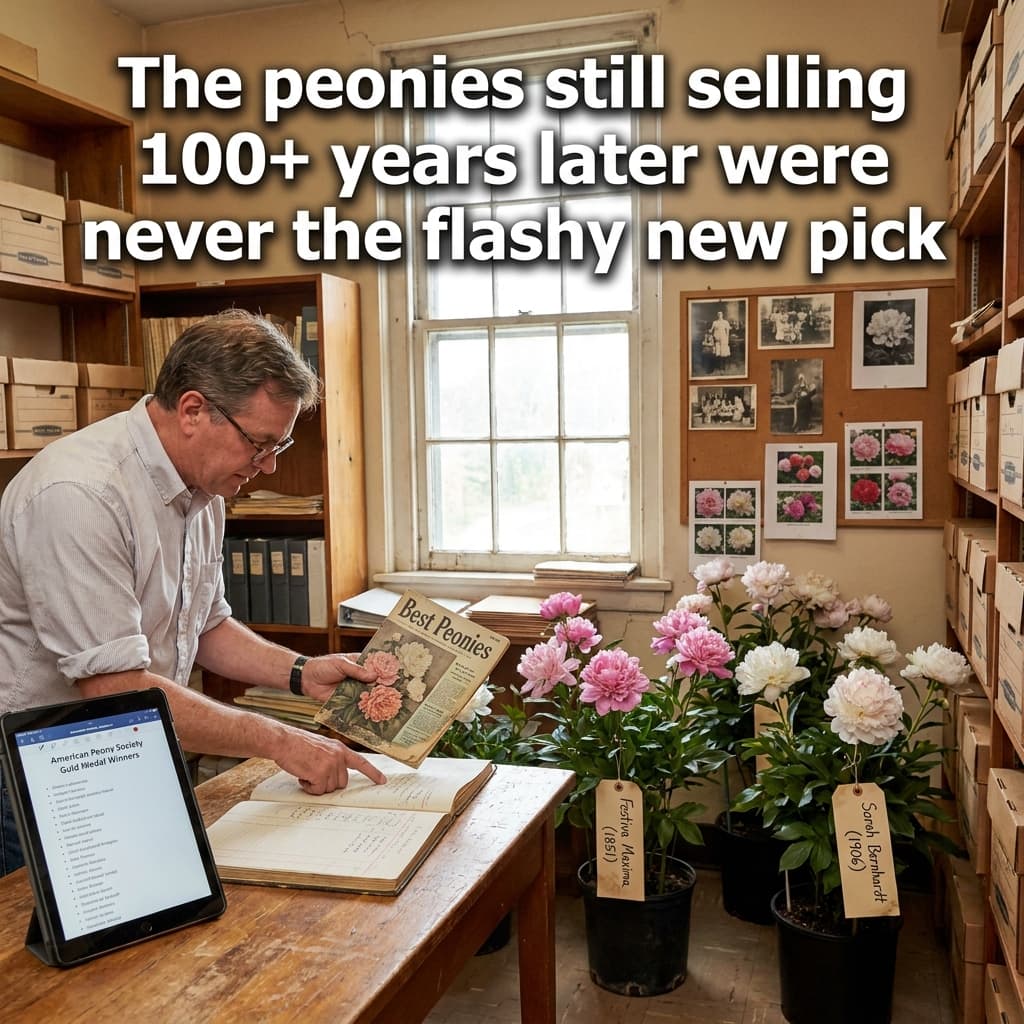
Two categories beat chasing a single best variety. For proven, widely available doubles, some long-sellers are safe and easy to find: Sarah Bernhardt (soft pink, introduced 1906), Karl Rosenfield (deep red), and Festiva Maxima (white flecked crimson, a 19th-century classic). All three are reliable at mainstream retailers.
For a currently recognized excellent bloom, the APS Gold Medal winners are the closest equivalent: Dreamtime (2024), Gay Paree (2023), Pastelegance (2022). Stock is not guaranteed at a local nursery, so specialty growers are the better source. Confirming availability and cold-hardiness zone first is worth doing.
Buying And Planting Notes
Peonies are planted from bare roots in fall. The eyes (growth buds) should be covered by no more than 1-2 inches of soil. Planting too deep is the most common reason a peony fails to bloom.
Full steps, depth, and spacing: how to plant and grow perfect peonies.
When an established peony will not bloom, the cause usually traces to planting depth, too little sun, or too much nitrogen. See why peonies will not bloom and common peony mistakes.
Frequently Asked Questions
Are old, vintage peony varieties still worth growing?
Some are, some are not. Sarah Bernhardt, Karl Rosenfield, and Festiva Maxima lasted a century or more because they are vigorous and disease-resistant, not because of any single show or award.
What does a peony Gold Medal actually mean?
The American Peony Society’s top award, factoring in bloom consistency and real commercial availability – a name gardeners can actually buy, not a one-time show standout.
Do all peonies need staking?
No. Full doubles need it most often, after heavy rain; single and Japanese/semidouble types typically stand upright alone.