
Hi GPODers!
There is never a bad time to garden—OK, being outside in the pouring rain or beating sun is unpleasant, but when you’re playing with plants it somehow makes it more bearable. However, there is a best time to garden and that is when you’re able to do it with a loved one. Joan Galloway in British Columbia, Canada hit the gardening jackpot with this incredible garden project she worked on with her daughter, Krista. We’ve seen Joan’s gardens a few times, but today she is introducing us to the garden she helped renovate and establish at her daughter’s new home in Brentwood Bay, British Columbia (Zone 8). The work was far from easy, but the gardens they created in the end (and the memories they made along the way) more than make up for any sweaty days or sore muscles.
I have sent you photos from my own gardens in the past, first from my garden in South Surrey, BC (Visions of Spring and Transforming a Garden with Good Bones) and, more recently from my new garden in the Cariboo region of north central BC (Five Years in a New Garden and Climate and Fall in Joan’s BC Garden, Part 1 and Part 2). Today I’d like to share with you photos of my daughter’s garden in Brentwood Bay, a small community just outside of Victoria, BC on Vancouver Island. In 2019 Krista bought a 100-year-old house that had started life as a small summer cottage and had been added onto over the years. A previous owner had been a dedicated gardener who planted many interesting plants but retained some of the ancient native trees already growing there, like Douglas fir (Pseudotsuga menziesii, Zones 4–6), Western redcedar (Thuja plicata, Zones 5–7) and Nootka cypress (Callitropsis nootkatensis, Zones 4–7).
However, for years before Krista bought it, the house had been used for short-term rentals, and the garden had fallen into disrepair, suffering badly from neglect, drought and the incursion of weeds and many invasive plants. Restoring the garden required enormous labour from the two of us for the first few years to remove the weeds and invasives, prune trees to let in more light and air, and remove irretrievably overgrown plants and shrubs. Rampant raspberries and a climbing rose that we nicknamed “The Beast” had to be tamed. Many plants that required sun were languishing in deep shade and needed to be moved. When Krista installed an extensive drip irrigation system to help with her long dry summers many dormant plants popped up to surprise us. Gradually the garden has come back to life.
 This is Brentwood Bay, situated on Saanich Inlet near Victoria, BC. A small car ferry connects Brentwood Bay with Mill Bay, a scenic 25 minute ride that gives access to communities farther up the east coast of Vancouver Island.
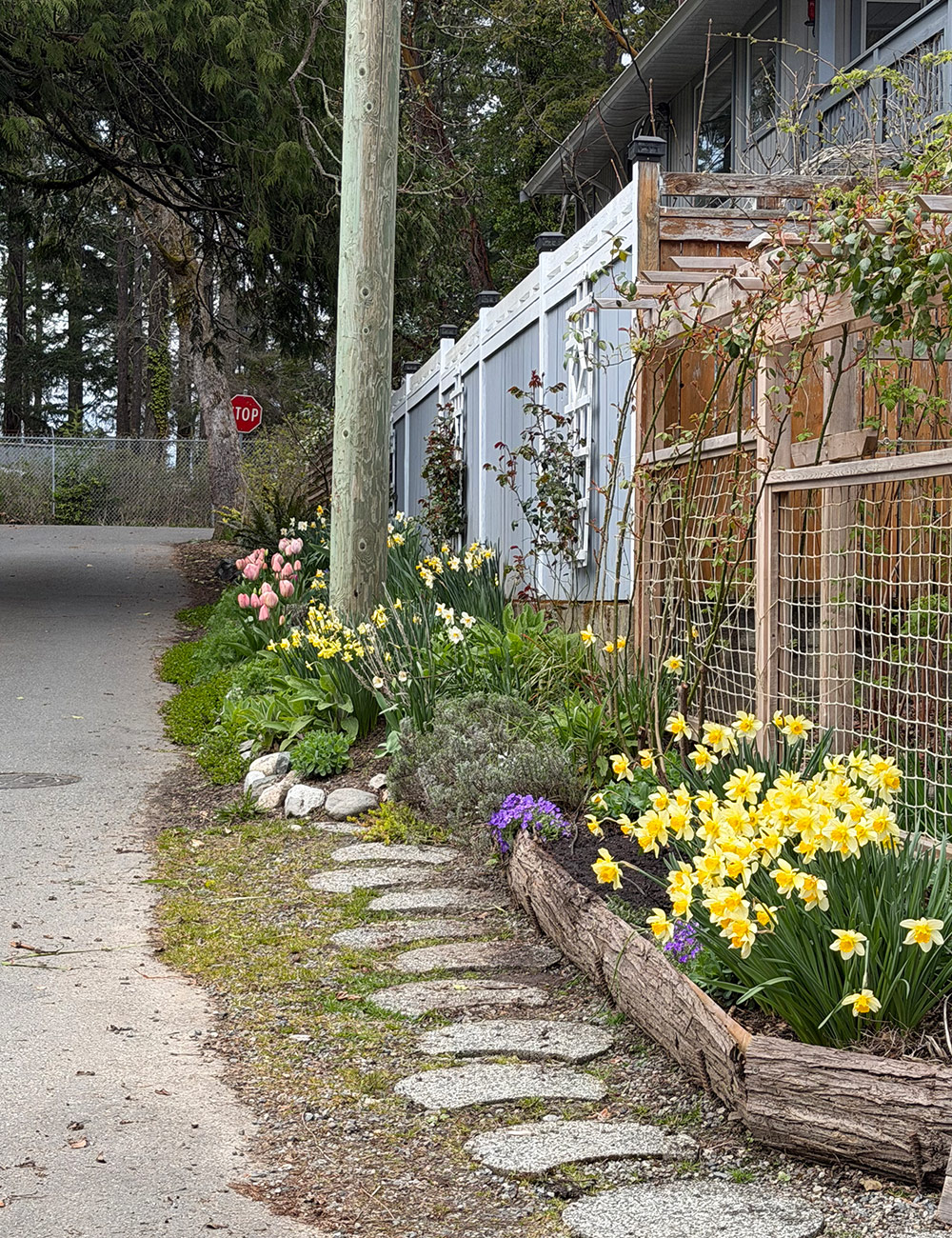 The fence line along the narrow road in front of the house. The neighbours have joined in planting a spring bulb display. Krista rebuilt the old fence using discarded fishing nets between the posts. It is reinforced at the bottom by wire to keep rabbits out of the vegetable garden behind it.
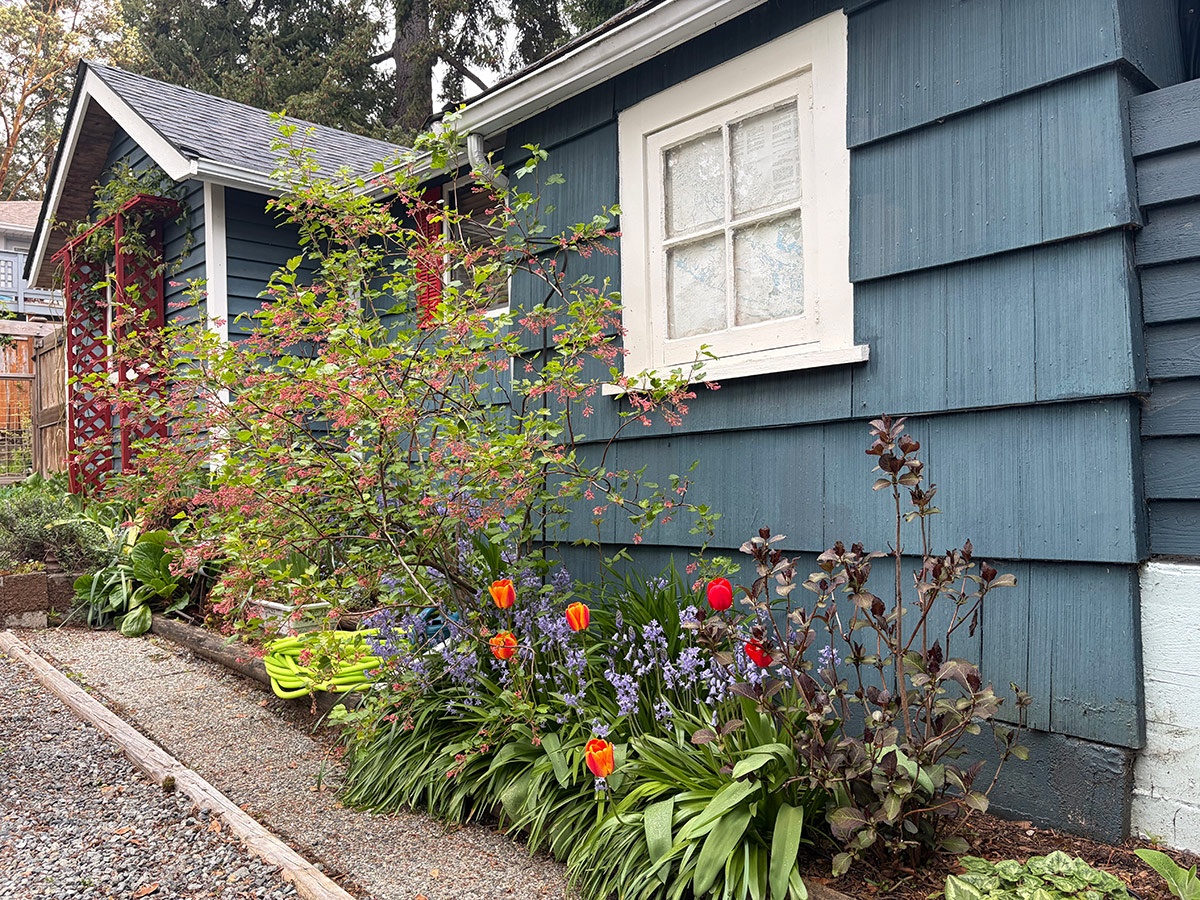 Colour echoes along the front of the old house. The red trellis supports “the Beast,” an ancient climbing rose, and is echoed by the red shutters, a King Edward VII flowering currant (Ribes sanguineum ‘King Edward VII’, Zones 6–8), which was rescued from deep shade in the back of the house, red and orange tulips set off by the bluebells (Hyacinthoides hispanica, Zones 3–8), and the emerging dark foliage of ‘Miss Saori’ hydrangea (Hydrangea macrophylla ‘Miss Saori’, Zones 5–9). ‘Miss Saori’ will be covered in huge mopheads of double pink flowers later in the season to complement the pink flowers of the climbing rose.
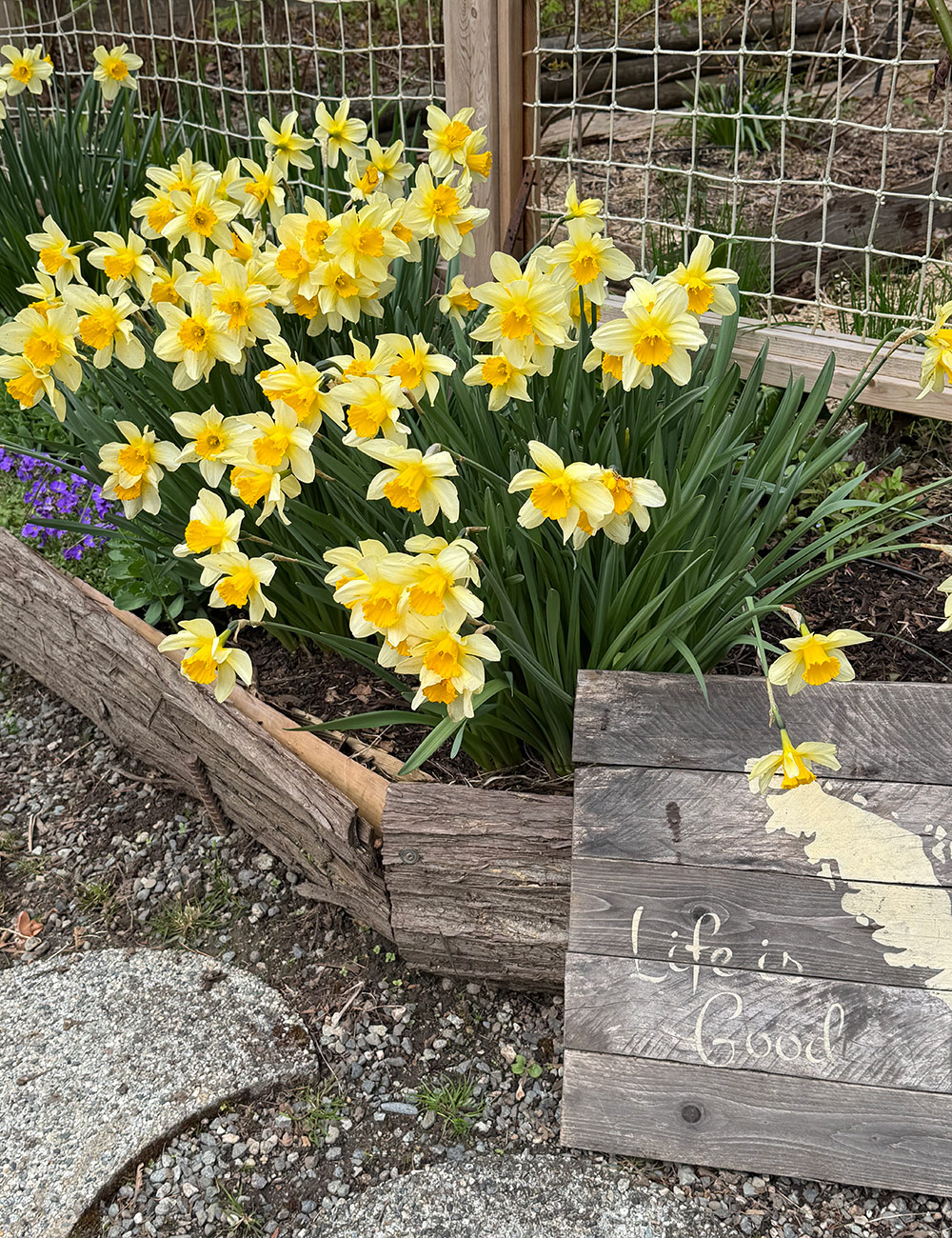 Daffodils grow in profusion in a raised bed along the road interspersed with trailing plants like aubretia and arabis. They will be succeeded by bluebells, ‘Lucifer’ crocosmia (Crocosmia ‘Lucifer’, Zones 5–9), foxgloves (Digitalis purpurea, Zones 4–8), lilies, and finally dahlias and ‘Autumn Joy’ sedum (Hylotelephium spectabile ‘Autumn Joy’, Zones 3–10) later in the year. Big old rose bushes are trained along the fence over top of it all.
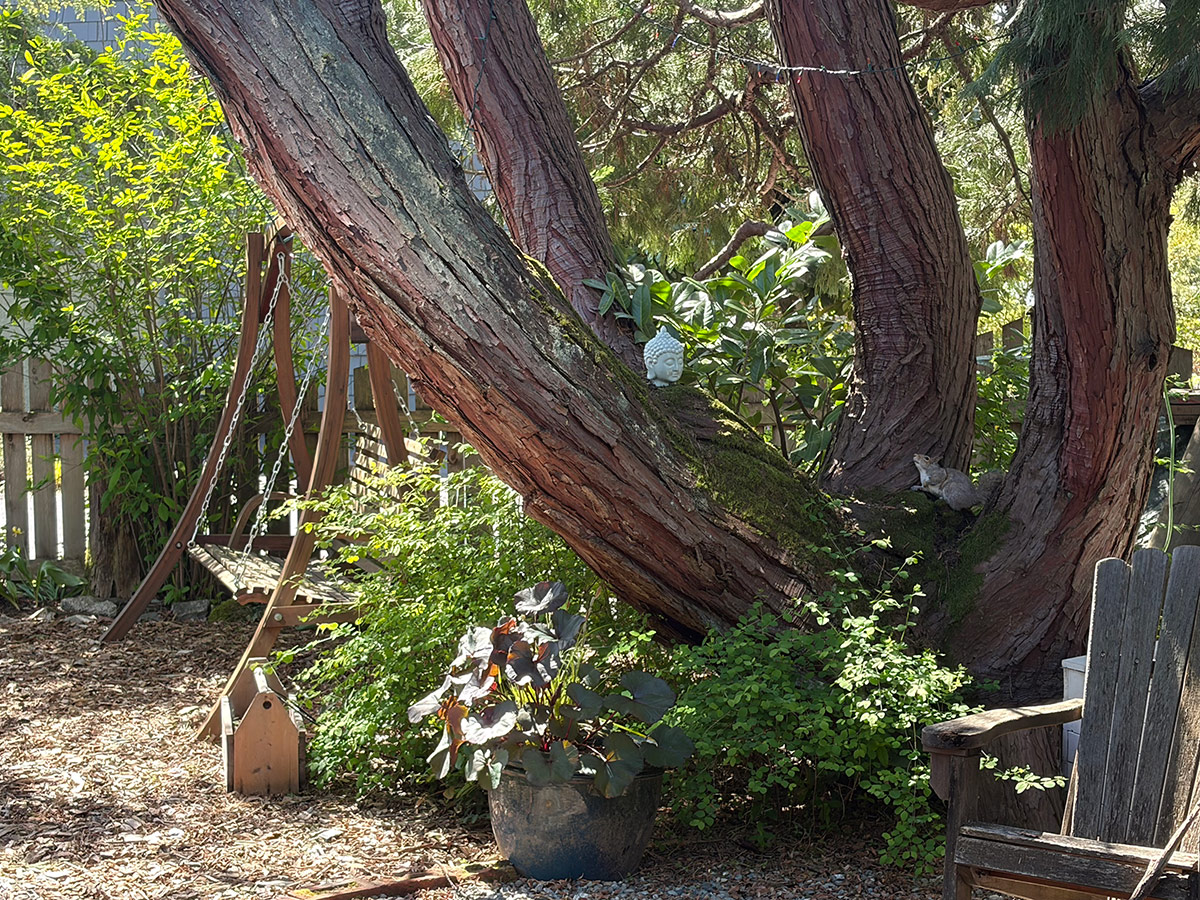 An ancient Nootka cypress (Callitropsis nootkatensis, Zones 4–7) anchors the lower yard. The container houses a ‘Britt Marie Crawford’ ligularia (Ligularia ‘Britt Marie Crawford’, Zones 4–8), Bowles Golden sedge (Carex elata ‘Aurea’, Zones 4–9) and Golden Japanese forest grass (Hakonechloa macra ‘Aureola’, Zones 4–9). Natives Snowberry (Symphoricarpos albus, Zones 3–7) and Indian plum (Oemleria cerasiformis, Zones 6–10) plus a self-seeded laurel fill in at the base of the tree. The squirrel is a regular visitor.
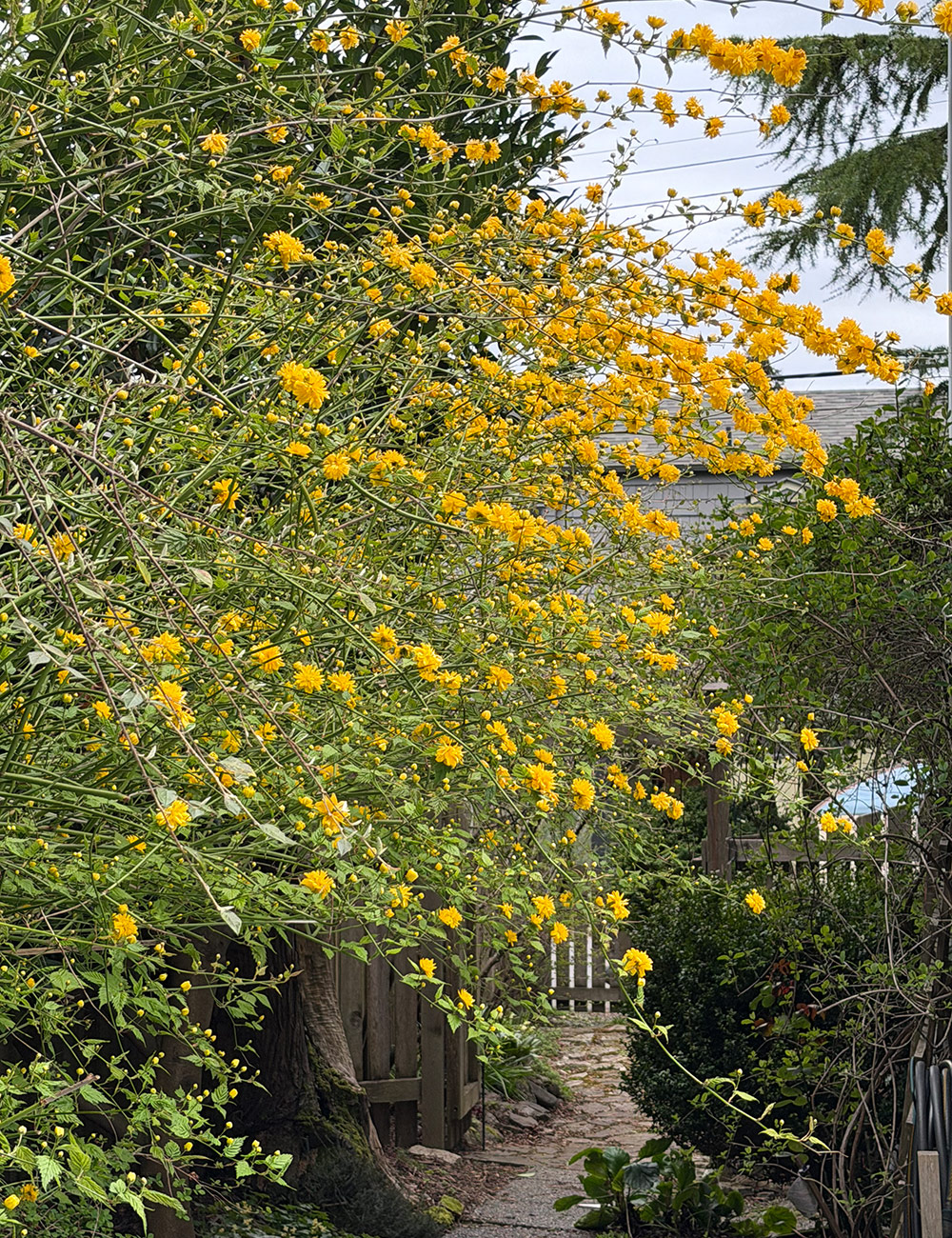 A huge Japanese kerria (Kerria japonica, Zones 4–9) grows under and through an even bigger Japanese camellia (Camellia japonica, Zones 7–9). The kerria arches over the back deck and frames the walkway leading to the lower yard. Robins are nesting in the camellia this year.
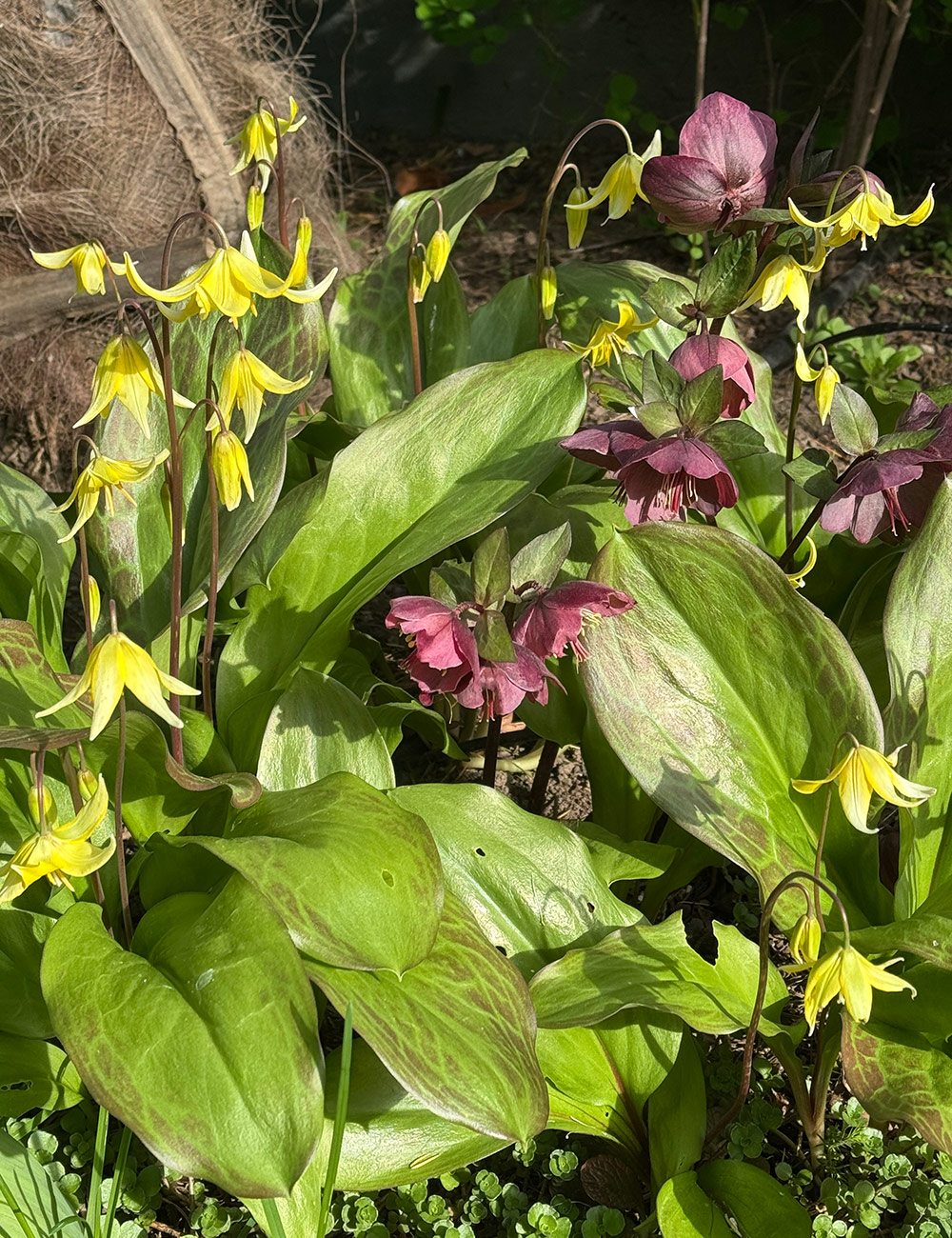 Hybrid ‘Anna’s Red’ hellebore (Helleborus ‘Abcrd02’, Zones 4–9) and fawn lily (Erythronium ‘Pagoda’, Zones 4–9) are a lovely combination for partial sun.
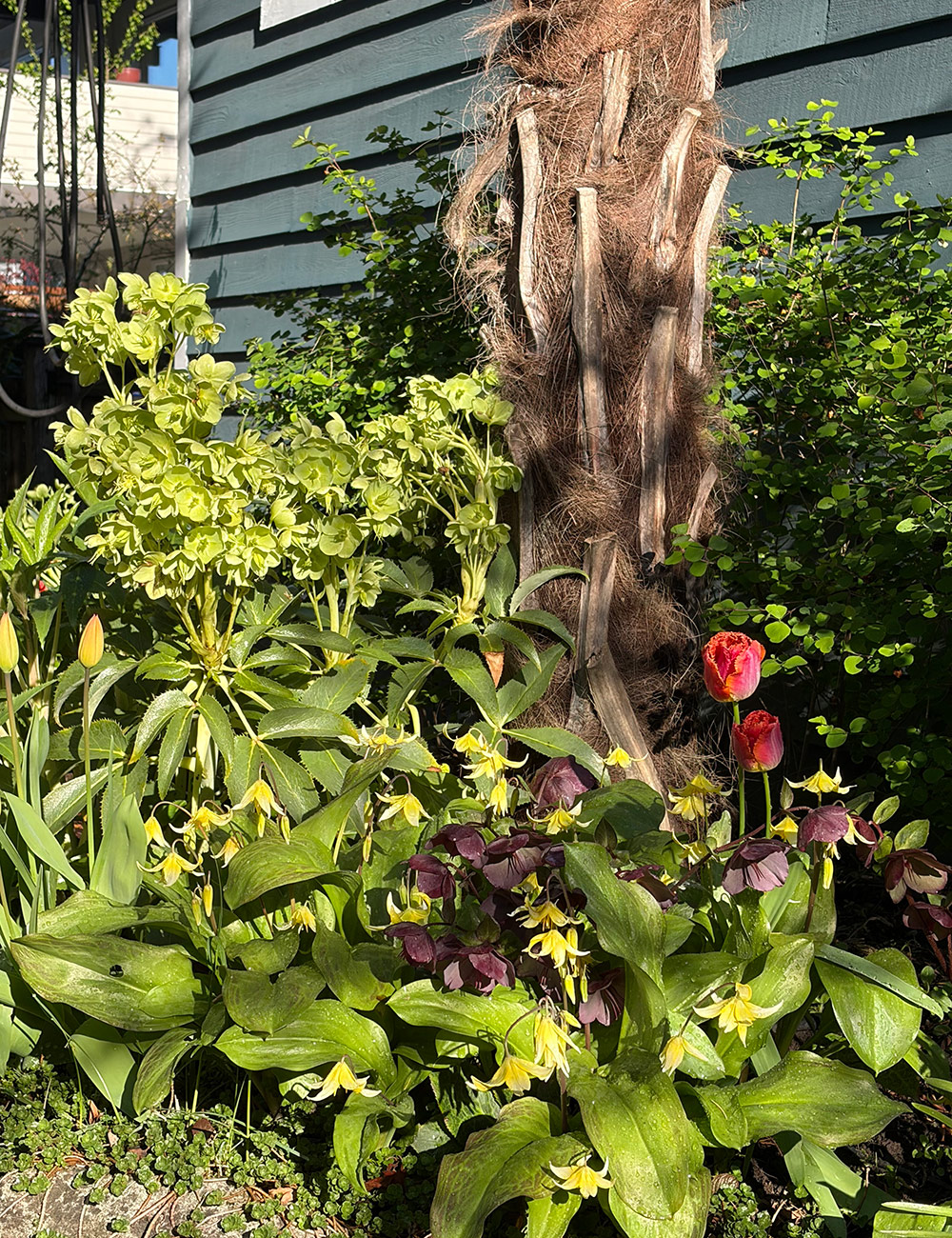 A windmill palm (Trachycarpus fortunei, Zones 7–11) placed close to the house for protection from cold, wind and rain has thrived and grown very tall. It flowers every year producing massive seed heads. House finches regularly nest in the trunk outside the second-floor bedroom window. Hybrid hellebores, fawn lilies and a Corsican hellebore (Helleborus argutifolius, Zones 6–8) enjoy the partial sun at the base and snowberries fill in the background against the house.
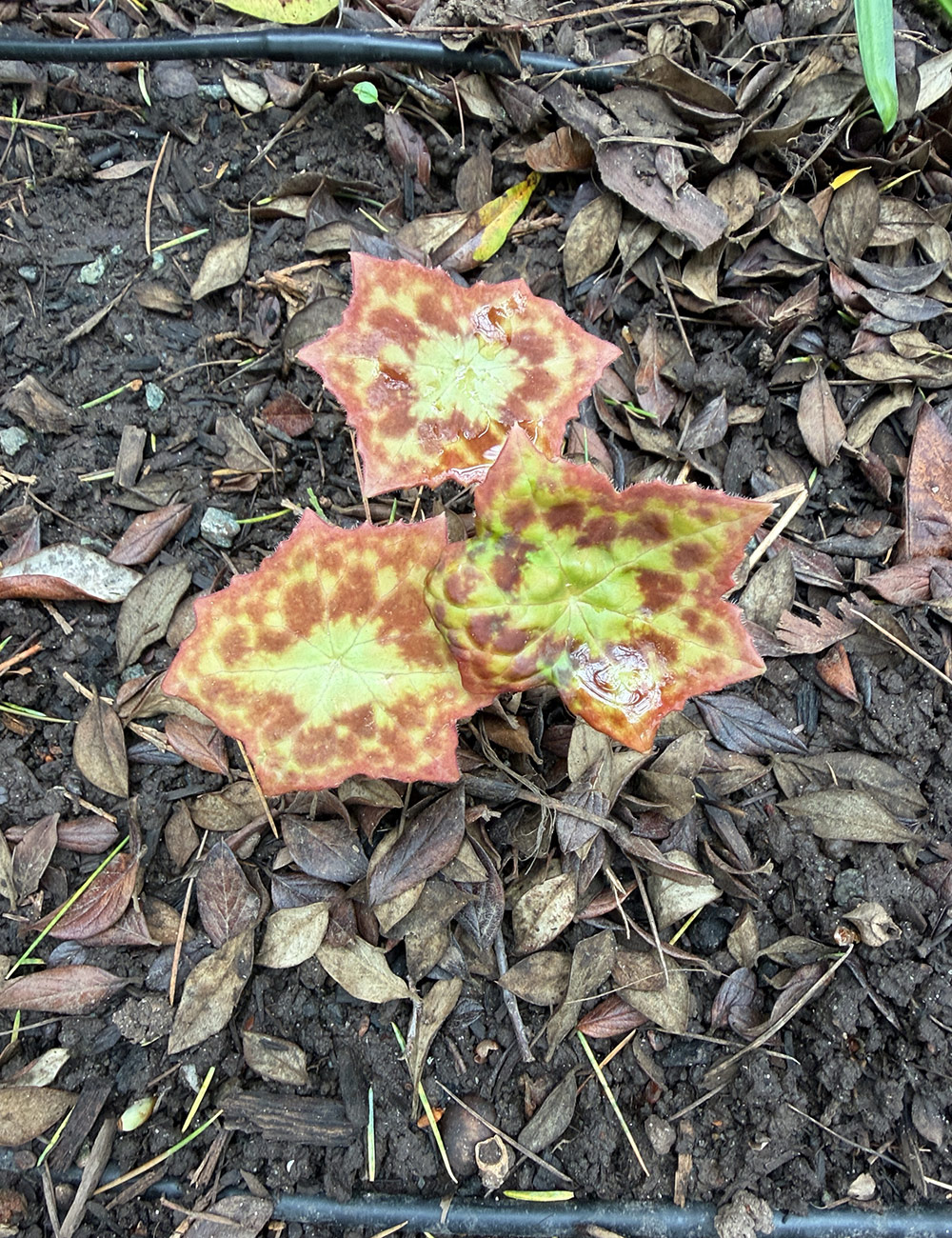 ‘Spotty Dotty’ mayapple (Podophyllum ‘Spotty Dotty’, Zones 6–9) is emerging in a shady nook.
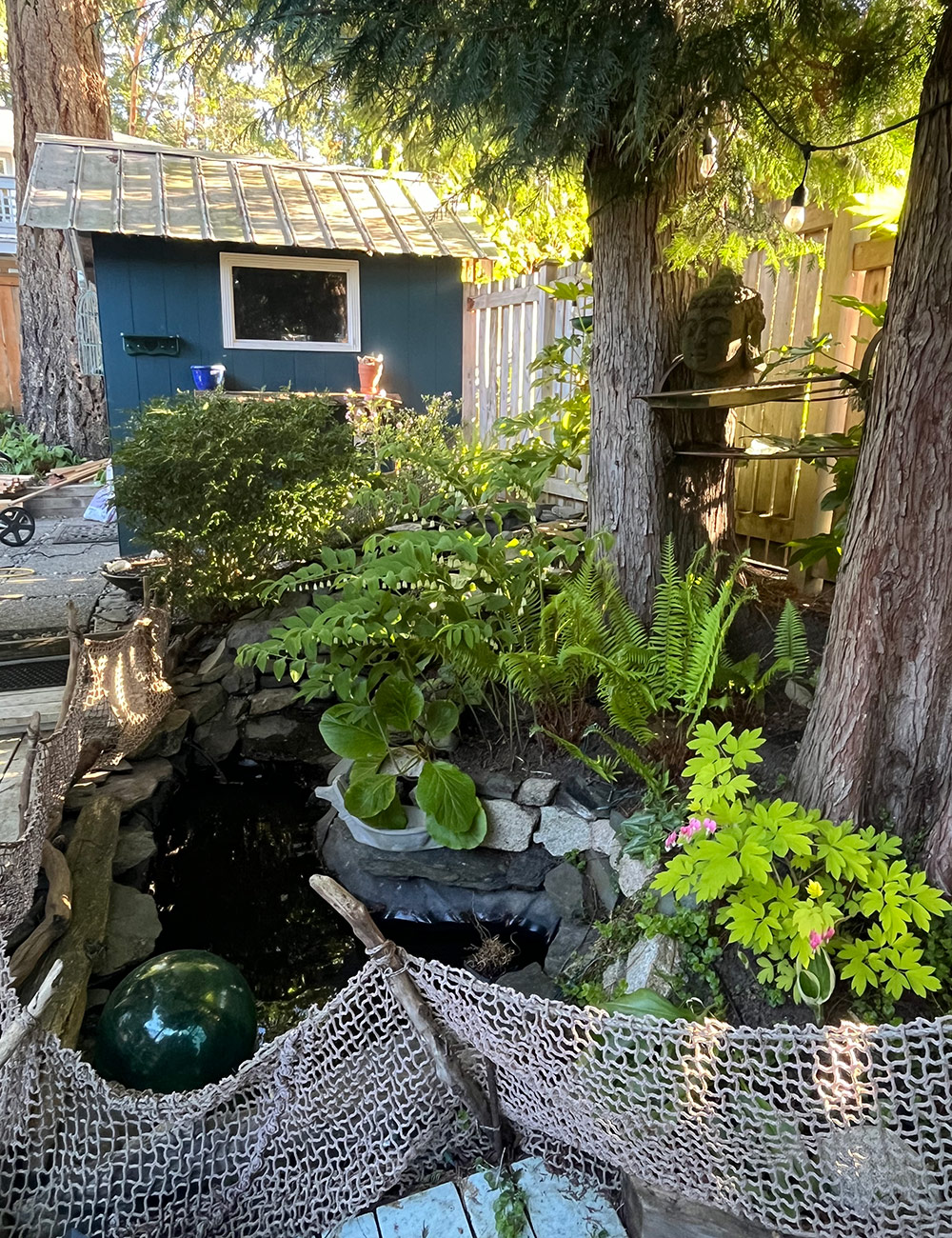 A trickling waterfall and small pond border the deck which is shaded by native Western redcedar and Douglas fir. A hummingbird has made its nest in the cedars. ‘Gold Heart’ bleeding heart (Lamprocapnos spectabilis ‘Gold Heart’, Zones 3–9), variegated Soloman’s seal (Polygonatum odoratum var. pluriflorum ‘Variegatum’, Zones 3–8), bergenia, hardy cyclamen (Cyclamen hederifolium, Zones 5–9) and native sword ferns (Polystichum munitum, Zones 5–9) border the pond. Japanese aralia (Fatsia japonica, Zones 7–11), several hellebores and fragrant sweet box (Sarcococca ruscifolia, Zones 7–9) are in the background by the shed and have to compete with dense tree roots. Later in the summer into fall a hardy ‘Little Giant’ fuchsia (Fuchsia ‘Little Giant’, Zones 7–10) will provide colour in this shady spot.
Thank you so much for sharing Krista’s garden with us, Joan! It is amazing that you were able to revitalize a gorgeous garden space while sharing the experience with your daughter. I hope we see more photos as it continues to evolve!
Spring is often the time when we start seeing the fruits of our labor. Whether it is planting a new garden bed, clearing out unruly and problematic plants, or starting an entire space from scratch, the work you do now (or in the fall) won’t have real payoff until the following spring. If you’re starting the enjoy the results of the garden work you did last year, we would love to see the new growth and plant beauty you’re experiencing. Follow the directions below to submit your photos to Garden Photo of the Day!
We want to see YOUR garden!
Have photos to share? We’d love to see your garden, a particular collection of plants you love, or a wonderful garden you had the chance to visit!
To submit, fill out the Garden Photo of the Day Submission Form.
You can also send 5–10 photos to [email protected] along with some information about the plants in the pictures and where you took the photos. We’d love to hear where you are located, how long you’ve been gardening, successes you are proud of, failures you learned from, hopes for the future, favorite plants, or funny stories from your garden.
Do you receive the GPOD by email yet? Sign up here
Fine Gardening Recommended Products
Johnny’s Selected Seeds Connecta® Cultivation Kit
Fine Gardening receives a commission for items purchased through links on this site, including Amazon Associates and other affiliate advertising programs.
Choose the right tool head for the job and switch out quickly with a simple push-button release. Includes the Connecta receiver, Connecta Collinear 4 head, Connecta Collinear 7 head, Connecta Contour Wire 4 head, Connecta Contour Wire 6 head, a sustainably harvested oiled ashwood handle, and a stainless-steel carrying clip.

The New Organic Grower, 3rd Edition: A Master’s Manual of Tools and Techniques for the Home and Market Gardener, 30th Anniversary Edition
Fine Gardening receives a commission for items purchased through links on this site, including Amazon Associates and other affiliate advertising programs.
Since its original publication in 1989, The New Organic Grower has been one of the most important farming books available, with pioneer Eliot Coleman leading the charge in the organic movement in the United States. Now fully illustrated and updated, this 30th Anniversary Edition is a must-have for any agricultural library.
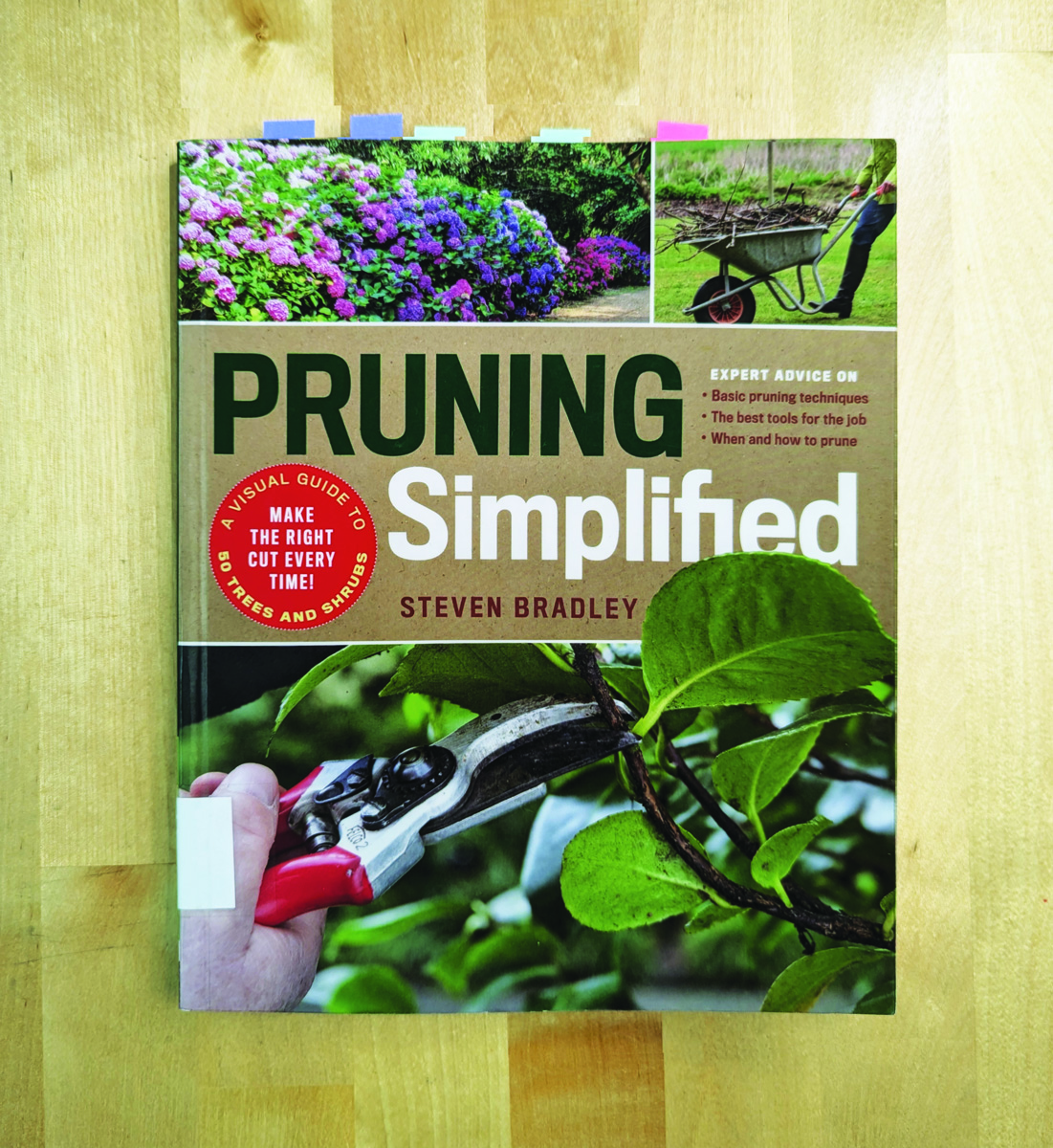
Pruning Simplified: A Step-by-Step Guide to 50 Popular Trees and Shrubs
Fine Gardening receives a commission for items purchased through links on this site, including Amazon Associates and other affiliate advertising programs.
Pruning Simplified shows you exactly how to do it. This must-have guide offers expert advice on the best tools for the job, specific details on when to prune, and clear instructions on how to prune. Profiles of the 50 most popular trees and shrubs—including azaleas, camellias, clematis, hydrangeas, and more—include illustrated, easy-to-follow instructions that will ensure you make the right cut the first time.