
August 22, 2026

Last Saturday we drove up Mount Blue Sky (formerly Mount Evans), one of Colorado’s 14ers — mountains 14,000+ feet in elevation. You need a timed-entry reservation to drive up “the highest paved road in North America.”
It takes about 45 minutes to switchback your way up 7,000 feet on a narrow road sans guardrails, with the added thrill of passing traffic, to a small parking lot just below the summit. From there you can climb a rocky but easy path, a little breathless and dizzy from the altitude, to the boulder-strewn summit. Now you’re standing at 14,268 feet above sea level.

The payoff? Blue peaks like a storm-tossed ocean as far as you can see. Clouds close enough to brush your hair. The treeline tonsuring bald mountaintops below.

We joined our fellow Blue Sky tourists — and their dogs — at the peak’s edge and took in the airy view.

I’d chosen an early reservation time in order to have us off the mountaintop before noon — ideally 11 am — per advice I’d read about avoiding the risk of a lightning strike on summer afternoons. We arrived at the ranger-staffed entry booth at 9:30 am, but I didn’t realize it would take an hour to reach the summit due to traffic and scenic stops along the way, plus climbing the footpath to the top.
Note to self: get there earlier next time. After all, there’s lots to see, including Mount Goliath on the shoulder of Mount Blue Sky, which is managed by Denver Botanic Gardens with alpine gardens and ancient bristlecone pines. I saved that stop for the downhill drive, hoping we could explore it before mushrooming thunderheads sent us scurrying for the safety of our car.

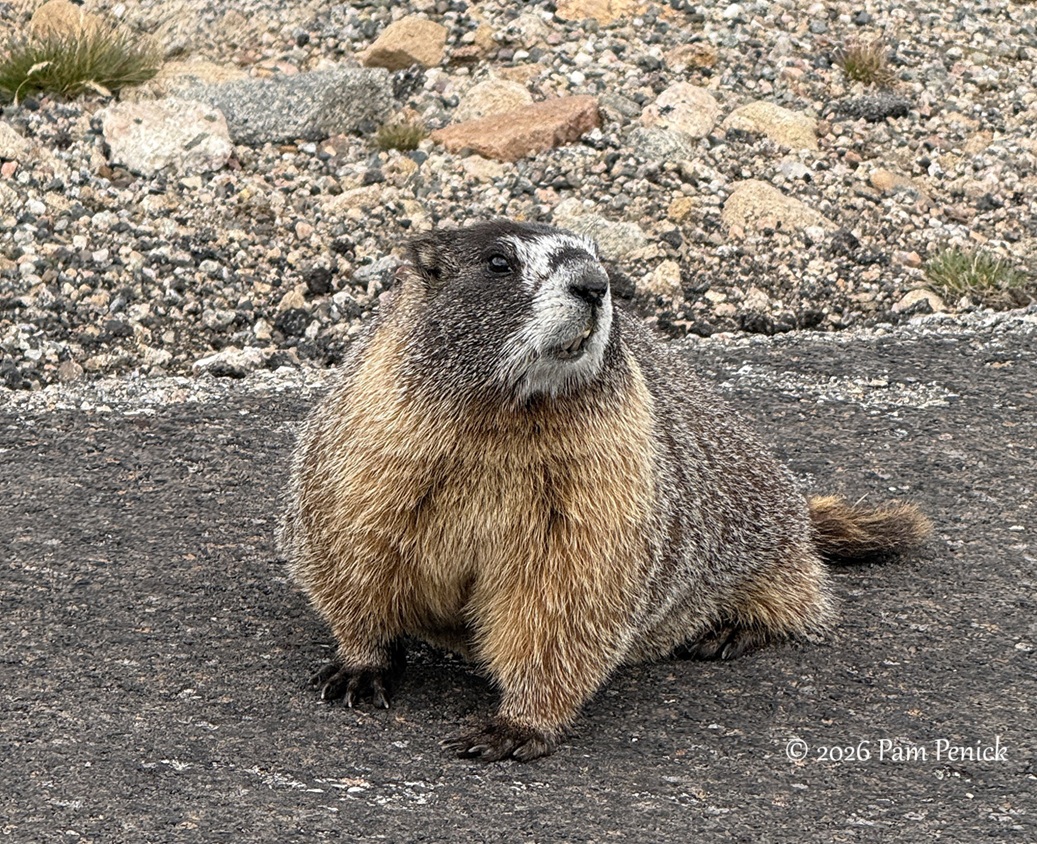
During the winding drive down from the peak, a yellow-bellied marmot padded into the roadway, slowing traffic as he stared beadily at passing cars, apparently on the hunt for a spare sandwich. Nope, don’t feed the wildlife, for their own good. He’s cute though.

At one pullout, a line of people staring through cameras and binoculars alerted us to a wildlife sighting, so we pulled in too. A trio of bighorn sheep were grazing on the hillside below.

Magnificent creatures. One had a partly broken horn, likely from a battle during the rut. Unlike deer, which shed their antlers each winter, sheep horns are for life, and so is any damage. But apparently they can get on just fine this way.

I wonder if he can still compete this fall.

Ewes have horns too but shorter and straighter.

Bighorns are Colorado’s state animal, and it was fun to see them on the mountain. We also hoped to spot mountain goats, but those eluded us. I’ve seen goats in Glacier, but I’ll keep looking for them here in Colorado.
Mount Goliath

Under darkening skies, we reached Mount Goliath around 11:30 am. Here, according to DBG’s website:
“Denver Botanic Gardens oversees the highest cultivated garden in the U.S., managed in conjunction with the U.S. Forest Service, Denver Mountain Parks and other collaborative partners. Visitors to Mount Goliath can enjoy the Dos Chappell Nature Center and surrounding cultivated gardens. The M. Walter Pesman Trail is three-mile loop, weaving through subalpine and alpine areas of bristlecone pines and wildflowers.”

Bristlecone pines are the longest living trees on earth, with a super slow growth rate due to altitude, cold, and wind. The bristlecones at Mount Goliath are between 700 and 1,600 years old — some of the oldest living trees in the world!

The nature center on site explained that there are two kinds of pines growing here, but I didn’t learn to distinguish between the two during our short stroll. So I can’t say for sure if all the trees I photographed are bristlecones. But the piney scenery was grand.

Bleached skeletons littered the ground like a boneyard…

…or driftwood.

Whether living or dead, they’re sculptural.


We started on the Bristlecone Loop…

…past trees with sinuous roots wrapped around boulders.

Fragrant needles sweetened the air.

Bark scars told a story of overcoming adversity.

These ancients are survivors, and they’ll make you feel small in the grand scheme of things.

Before we’d walked far, though, we heard a rumble of thunder, so we turned back. It’s a good thing we did because the skies soon opened, dumping rain and a little hail. We enjoyed a car picnic before heading back down the mountain toward home.
I welcome your comments. Please scroll to the end of this post to leave one. If you’re reading in an email, click here to visit Digging and find the comment box at the end of each post. And hey, did someone forward this email to you, and you want to subscribe? Click here to get Digging delivered directly to your inbox!
__________________________

Digging Deeper
“Gardens of Texas is not your typical door stop/coffee table book filled with beautiful images of gardens you can never hope to achieve. The photography is definitely inspiring, but Pam’s thoughtful, detailed storytelling and “Try This At Home” features…makes one feel empowered to create similar garden magic….This is what I’ll curl up with on late August afternoons when the mercury in Austin soars and I’m stuck indoors.”
–MomInAustin, a reviewer on Amazon
Gardens of Texas: Visions of Resilience from the Lone Star State is here! It’s for anyone who loves gardens or the natural beauty of Texas. Find it on Amazon, other online book sellers, and in stores everywhere. More info here.
On September 12, tour three private Denver-area gardens through the Open Days Program. Details and tickets at the Garden Conservancy.
All material © 2026 by Pam Penick for Digging. Unauthorized reproduction prohibited.