




No, you don’t need a gym to get strong.
Bodyweight training and weight training are both strength training, and both run on the same principle: progressive overload.
In a gym you add weight to the bar; at home, you change your leverage.
Each has real advantages. Bodyweight goes anywhere, needs little or no equipment, and is still highly scaleable. Weights make heavy loading and progression math simpler, and cover pulling exercises more easily.
Your progress is based on the principles of training, not a specific location.
Here’s how that works, and why one reader’s plan got derailed by a single sentence from a friend.
Enter Ant-Man
I was chatting with a reader a couple of weeks ago – let’s call him Ant-Man to protect his secret identity. 💪
He’s been doing awesome with tracking his food and dialing in his nutrition. But on the workout side of things? He was feeling stuck.
So we decided to start off with a bodyweight routine at home.
Then he told a friend about it.
To paraphrase, his friend said something like:
“That’s kinda pointless. You’re gonna have to go to a gym eventually if you want to make progress.”
When I followed up with him, Ant-Man told me this:
“I feel kinda silly admitting this, but it really deflated me. And I haven’t been able to get myself to workout for the last month.“
First things first: it’s not silly to feel that way. That kind of comment lands hard when you’re already unsure about starting.
The real bummer is that these types of comments are rampant within the fitness industry as a whole – not just from friends, but from other personal trainers and strength coaches. “It only counts if you do it THIS way.”
And. It. Drives. Me. CrAzY.
It only puts more barriers between people and the thing that would help them.
It keeps folks stuck waiting for the “right” way instead of starting with the good way that’s available today.
Even if the claim that you eventually need to go to a gym were true, it’d be bad advice to give someone.
Lucky for us, it also happens to be untrue. Let me show you why.
Can you get really strong with bodyweight training?
Yup.
Here’s the thing that often gets confused about bodyweight training and weight training – they are BOTH strength training, and they operate on the exact same engine: progressive overload.
Challenge your muscles, let them adapt, then increase the challenge.
With weights in a gym, you add pounds to the bar or the machine.
With bodyweight, you change your leverage. I.e. you put yourself at a mechanical disadvantage so your muscles have to work harder to perform the same task:
- Squat -> Staggered squat -> single-leg squat (you’re increasing the load that each individual leg supports)
- Incline push-up -> floor push-up -> decline push-up (changing the angle changes how hard your muscles have to work)
Same principle, regardless of where you train or what implement you use. 😃
And the ceiling is much higher than people think. Look at gymnasts and calisthenics athletes – they are some seriously strong, seriously muscular humans built largely on leverage and bodyweight.
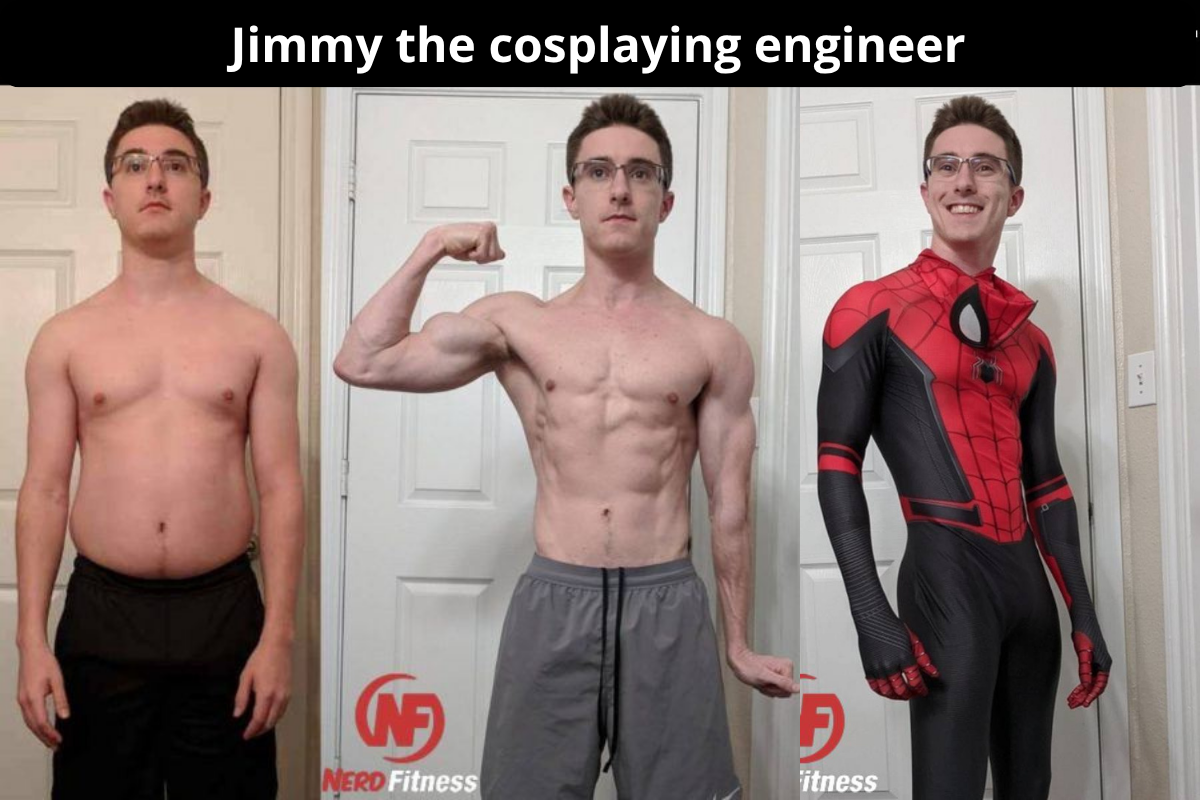
Or look at our client Jimmy – he trained at home, got strong, and cosplayed as his favorite superhero: Spider-Man.
Jimmy had the exact same concern when he started out – he didn’t enjoy going to the gym, had a packed schedule, and wasn’t sure if he’d be able to make serious progress at home. 12-months later, and he was ready to swing around the Spider-verse. 🕸️
Bodyweight training has it’s own set of superpowers:
✅ Travels well (living room, hotel, park, etc.)
✅ Minimal (or zero) equipment required
✅ Highly scaleable based on your current ability level
OK, so what about the gym?
Let’s be fair to Ant-Man’s friend. Weights and gyms have real advantages, too:
- Simpler progression math. Sometimes it’s easier to add 2.5 or 5 pounds to a movement than to find your next leverage tweak.
- Heavier loading (especially for the lower body). If your goal is maximal raw strength, a barbell lets you load beyond what bodyweight alone can. You can still build an awesome foundation of lower-body strength and power with bodyweight exercises – a barbell just makes really heavy really convenient.
- Pulling exercises. If you’re going strictly no equipment, rowing exercises can be harder to perform at home. (Though a cheap pair of gymnastics rings or some creative towel set ups go a long way.)
- A separate space. For some people, the gym is where they step away from everything else and focus on themselves. That can be valuable in and of itself.
Some people love the gym.
Some people love training in their living room.
Some people do both, depending on the season of life.
It’s all good stuff.
The real deal about progress
Your progress, especially when you’re getting started, isn’t owned by a place or a piece of equipment.
It’s made of principles, and you can dial them up wherever you are:
- Increase intensity – add weight, or decrease your leverage
- Increase volume – add a rep, a set, a round, or an exercise
- Introduce novelty – a new exercise variation, angle, or position can help if you’ve stagnated
So the question isn’t “which type of exercise counts?”
It’s: which one works for you, consistently, in your life right now?
For Ant-Man, that’s a bodyweight routine at home.
For his friend, that may be the gym.
Both totally cool.
So if you’ve found yourself thinking, “It doesn’t really count unless I….”
W’ere here to help.
You got this. 💪
-Matt
Whenever you’re ready, here are the ways we can work together:
1) If you’re where Ant-Man was, ready to start but no gym in the picture, grab our free Bodyweight Adventures Workouts. They are scalable, progression-based, and doable in your living room with little to no equipment. [Snag the workouts HERE]
2) We’ve helped thousands of nerds build confidence in their fitness. 🔥 This video shows the exact systems we use.