
Modern living gives us access to constant news, entertainment, and communication with others. Our culture tends to value the present and the future, more than the past. Why would we want to build a garden that looks back to our past? Can looking back be good for us?
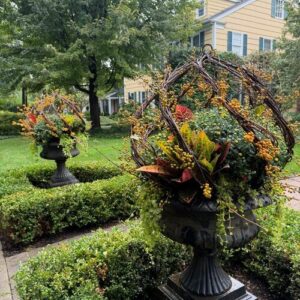
Traditionally, a memorial garden is a peaceful space to remember or grieve a loved one. It might be a cemetery, a public park, or something as small as a container garden on a balcony engraved with a loved one’s name—a living tribute. It can also exist in your backyard or as a dedicated area within your garden.
Memorial gardens are created for healing, reflection, gratitude, and celebrating life. They can reflect your family, pets, your childhood home, and your heritage. A memorial garden can slow you down, bring you peace, and foster a sense of grounding. Remembering can offer warmth and remind you of your unique place in the world.
What elements should you consider when creating a memorial garden?
- Include objects or mementos that make you remember the person, pet, place, or memory that you want to cherish.
- Create seating or spaces that invite you to pause and reflect.
- Incorporate sensory elements—such as water fountains, wind chimes, or birdbaths—to deepen the experience of nature and encourage contemplation, meditation, or prayer.
- Choose plants that remind you of meaningful people or places you miss.
The Soods and their remembrance garden

I recently had the great fortune of renovating an extraordinary garden owned by Rekha and Narender Sood, which beautifully embodies these elements. As a young couple, the Soods moved from India to the United States and settled in Bellevue, Washington, in 1982. Over time, they found their permanent home—and the perfect place to create a deeply personal garden.
Originally designed in 1999 by landscape designer Dan Borroff, the garden was conceived as a sanctuary reflecting the homeowners’ heritage and family. It features a large hand-carved pavilion, stone statuary, a small teahouse, a reflection pond, and numerous ceramic containers—all sourced from India. Borroff organized the space into a series of garden rooms, each with distinct focal points, stepping down the hillside from the house.
Twenty-five years later, the garden was ready for renewal. The structures needed stabilization, and the landscape called for a refreshed vision. I was brought in to enhance the garden while honoring its original spirit. My goal was to strengthen the presence of the existing elements by using strong axis lines and plantings to guide the eye. New steps, railings, path edging, and lighting improved safety and circulation, while terraced retaining walls stabilized the slope and added drama to the central pavilion space.
Art and plants provide meaning and direction
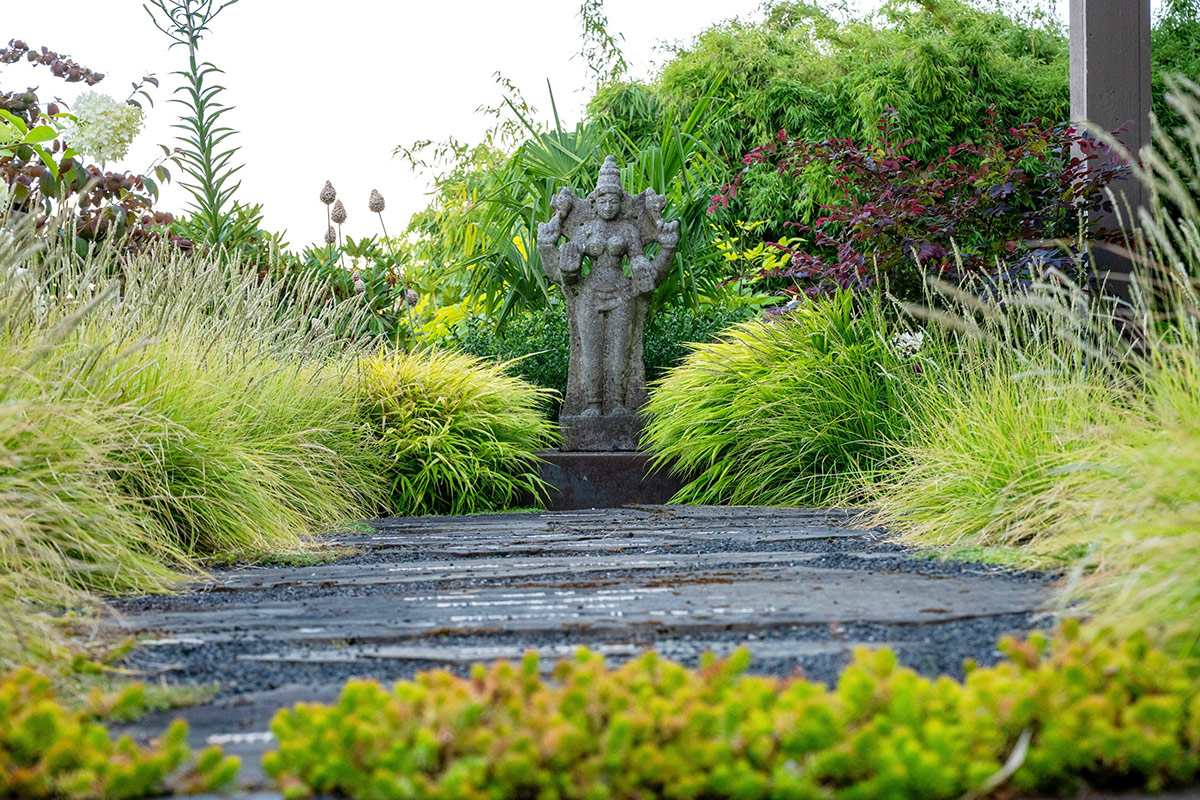
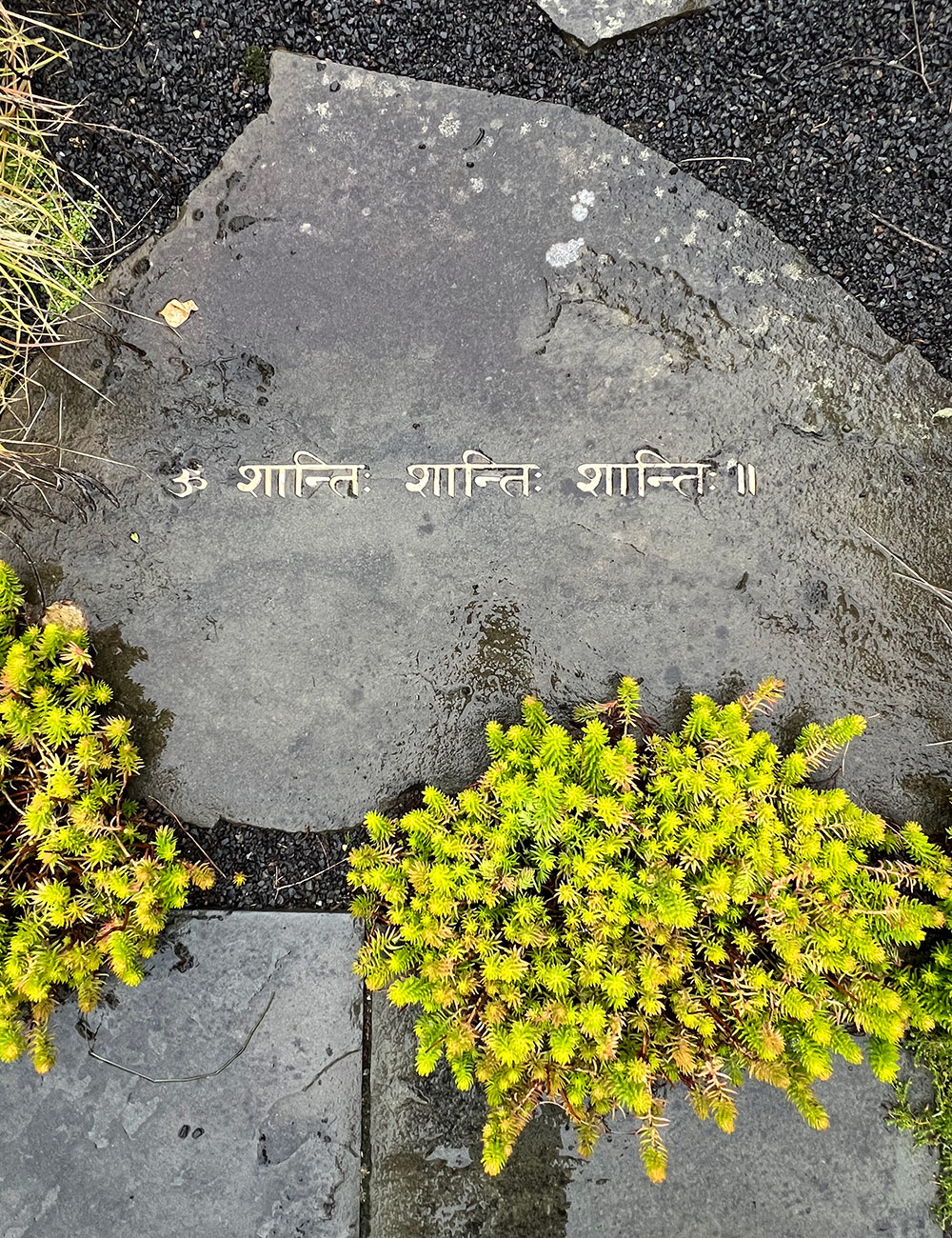
Near the house, a memorial honors Narender’s mother, Shanti. A stone path engraved with the prayer “The Shanti Path” was commissioned locally by Borroff and serves as both a literal and symbolic journey toward peace. At the end of the path is the goddess Bhudevi, representing the nurturing force of Mother Earth. The flagstones were realigned along a clear axis, and the statue was elevated on top of a custom steel box to give her a commanding presence. Bright yellow ‘Angelina’ stonecrop (Sedum rupestre ‘Angelina’, Zones 5–8) marks the start of the path. Autumn moor grasses (Sesleria autumnalis, Zones 5–8) were added along both sides of the flagstones to direct visitors’ attention toward both the prayer and the statue.
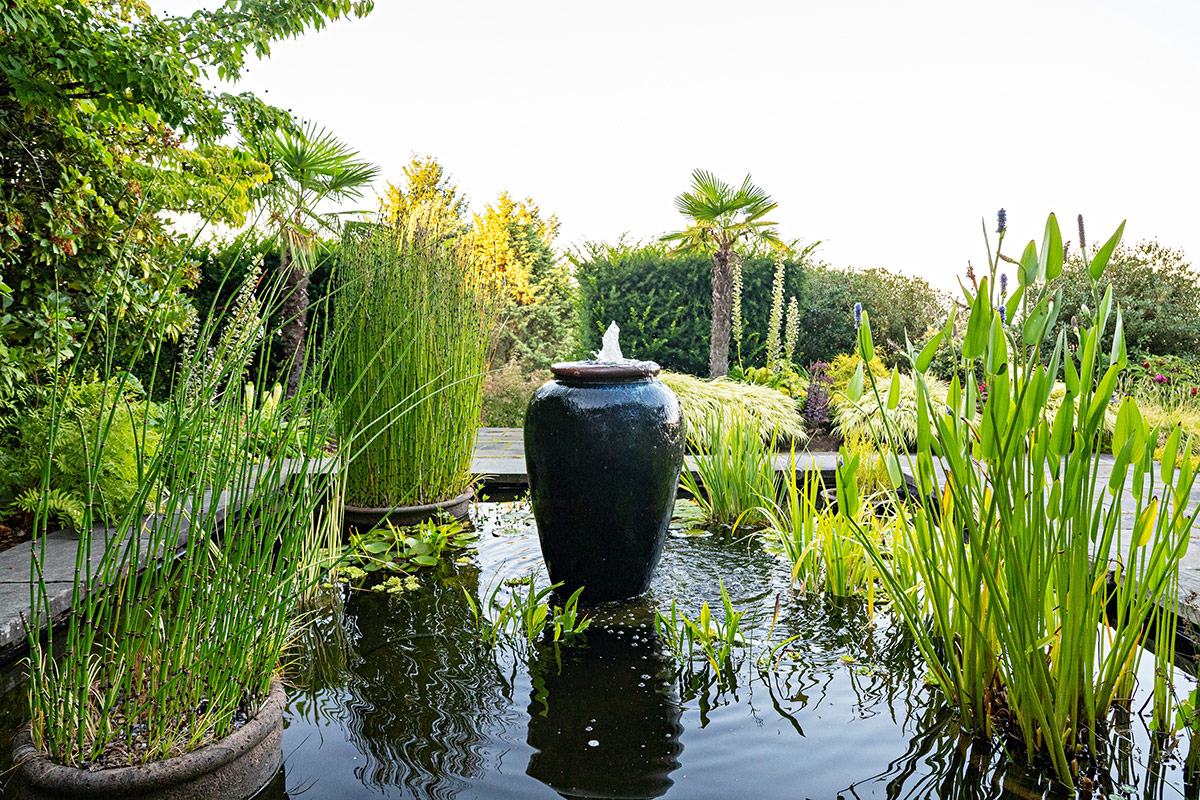
Opposite this memorial lies a reflection pond, visible from both the house and garden. A low ground cover of dwarf mondo grass acts as a second frame for the pond, accentuating its bold shape and connecting it to the landscape. There is a bench swing for two in the middle of the space to sit, reflect, and take in the views of the lake below.
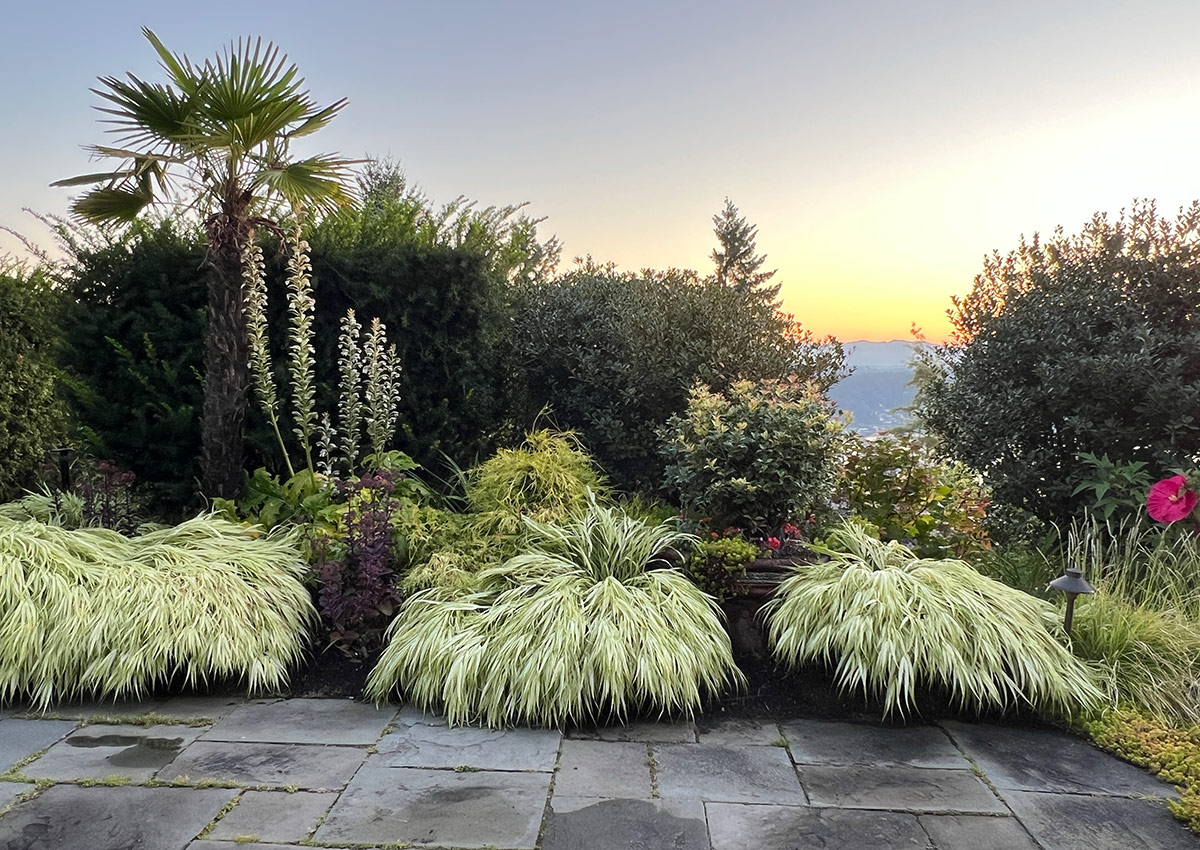
Windmill palms (Trachycarpus fortunei, Zones 7–10), golden Japanese forest grass (Hakonechloa macra ‘Aureola’, Zones 5–9), bear’s breeches (Acanthus mollis, Zones 7–10), ‘Tugela Jade’ pineapple lily (Eucomis ‘Tugela Jade’, Zones 6–9), and swamp rose mallow (Hibiscus moscheutos, Zones 5–8) were planted throughout to create the feeling of being in subtropical India.
Paths and plants dictate how the garden is experienced
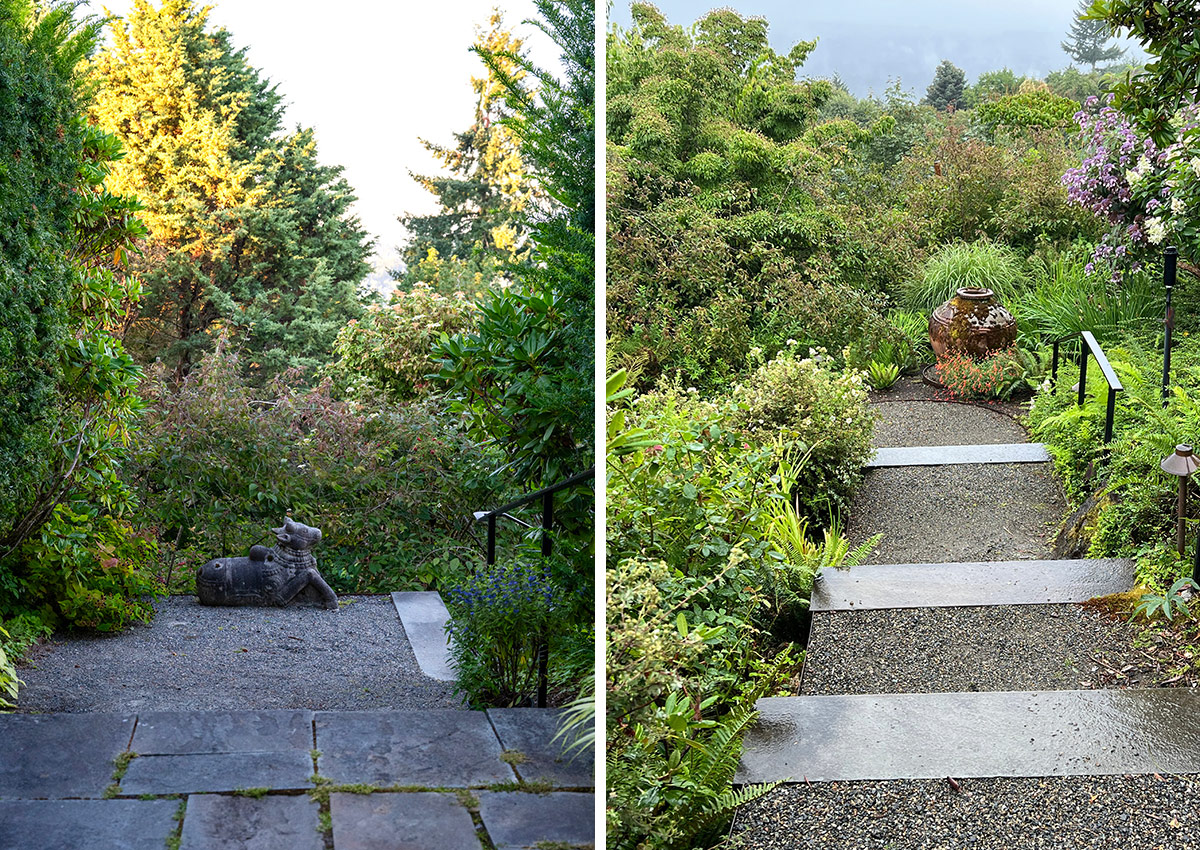
Leaving the upper garden room and down a flight of steps sits a carved stone bull, pointing the way east down the path. A large ceramic container sits at the end of the corridor, stopping the eye as the path pivots to the left and continues onto the large pavilion room.
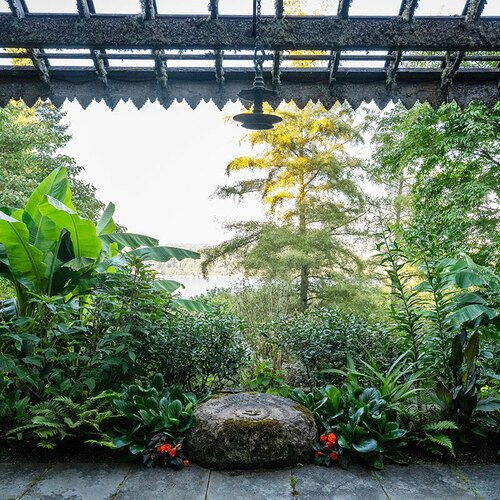
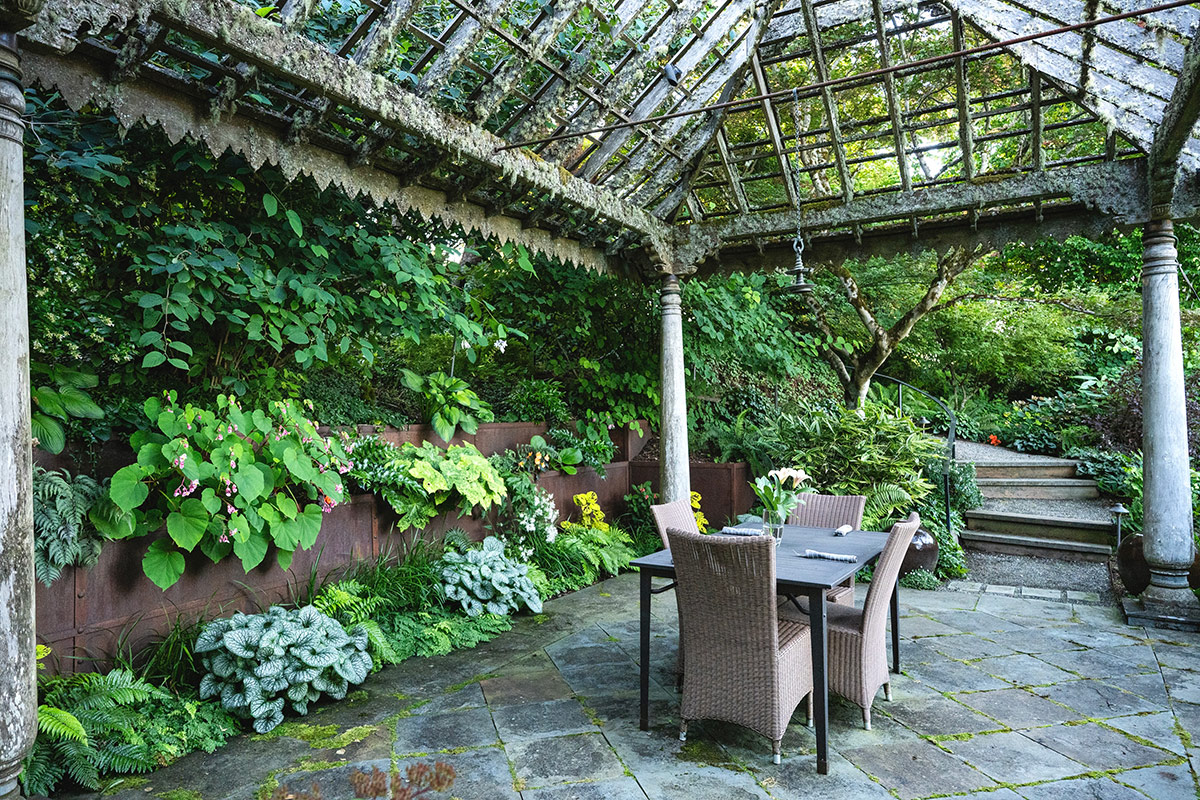
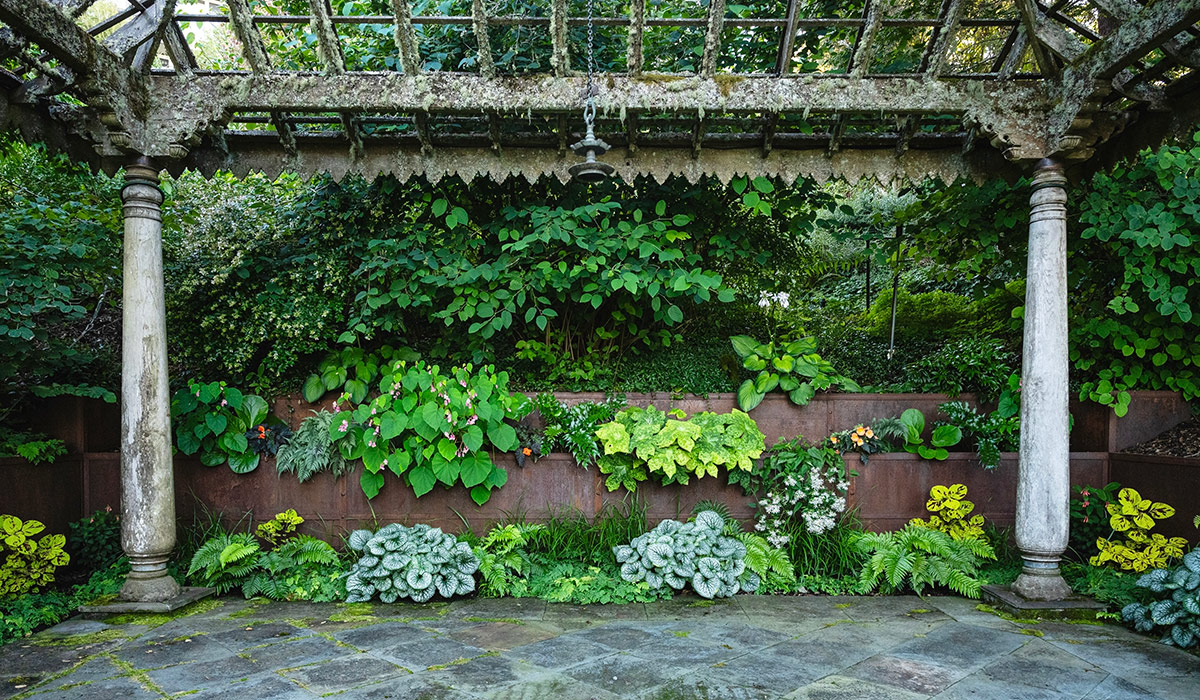
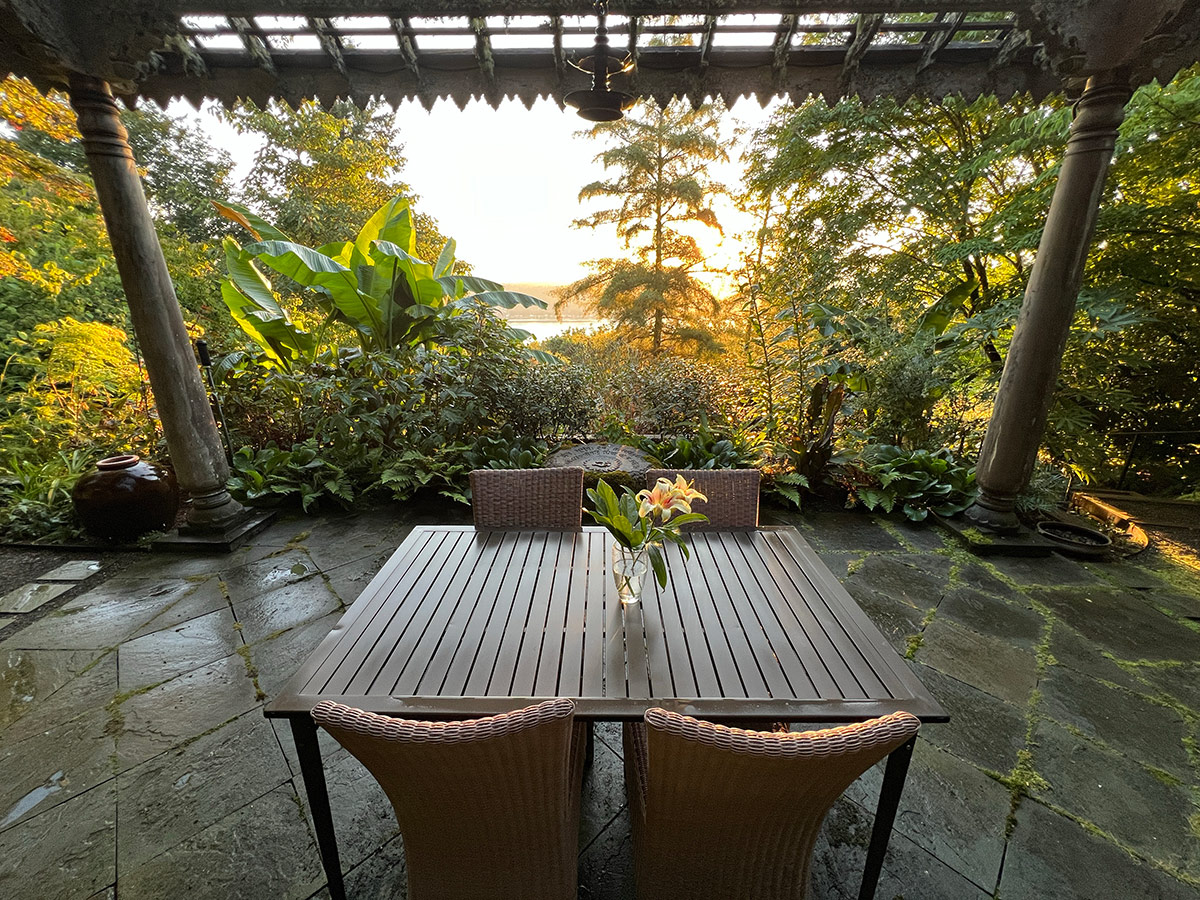
In the center of the pavilion room sits a very large stone engraved with the Vedic prayer, the Gayatri mantra, in remembrance of Rekha’s mother. This ancient mantra was chanted by her mother during difficult times, with the purpose of instilling wisdom or taking the mind from darkness into light. This large stone is the focal point of the pavilion and draws the viewer closer to the lake views below. Symmetrical plantings reinforce its significance. A terraced rusted steel wall with battens and rivets was designed to retain the slope, to create planting pockets for a wall of living plants and to make the space feel old and worn. Hardy begonias (Begonia grandis, Zones 6–7), tassel fern (Polystichum polyblepharum, Zones 5–8), ‘Spotty Dotty’ mayapple (Podophyllum ‘Spotty Dotty’, Zones 6–9), ‘Bronze Orange’ canna (Canna × generalis ‘Bronze Orange’, Zones 7–11), and hardy banana trees (Musa basjoo, Zones 5–10) create rich texture and color, transporting visitors to a distant landscape. A table and chairs encourage lingering.
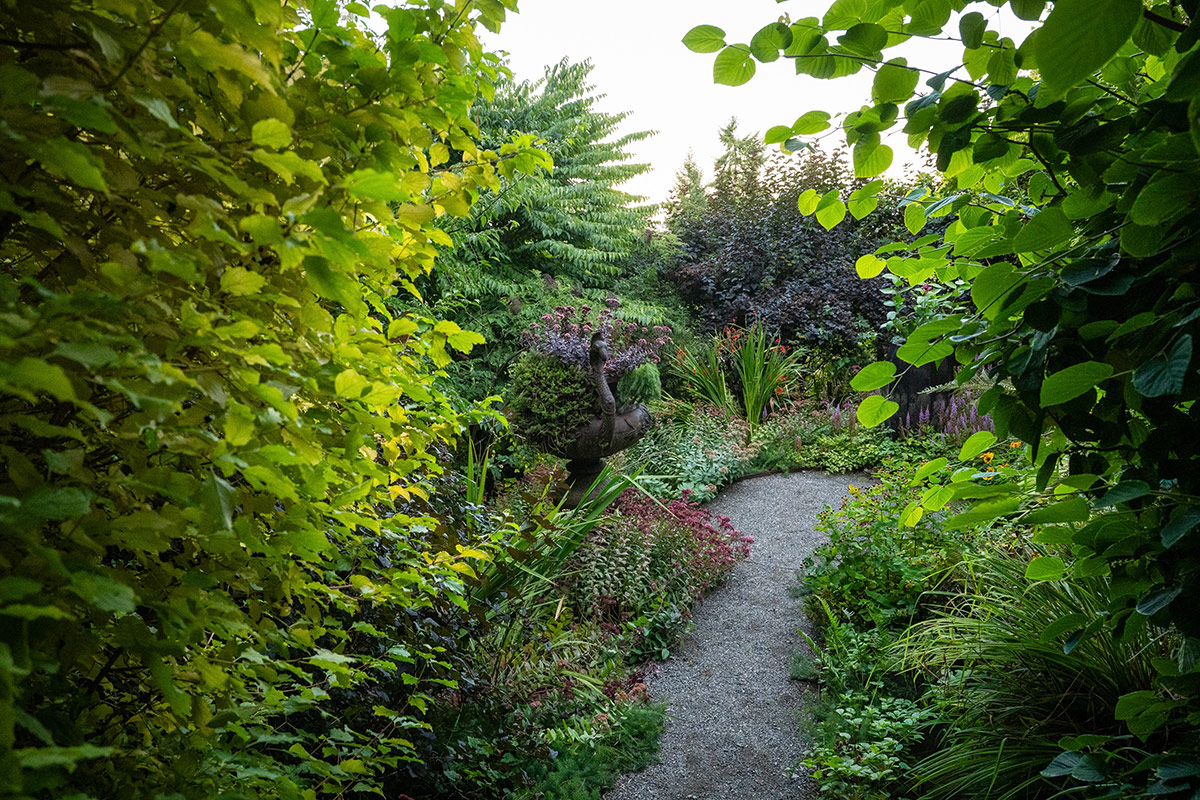
Farther down the hillside, a side path leads to a pet memorial area—a quiet stone patio with a ceramic vessel, offering a place to pause. Beyond this lies the Fire Garden, defined by a gravel space encircled in a steel edging. At its entrance stands a 6-foot-tall Phoenix Rising planter, symbolizing death, rebirth, resilience, and transformation. The plant palette reflects this theme, with warm tones—pink sedums, yellow euphorbias, and fiery red-orange crocosmia.
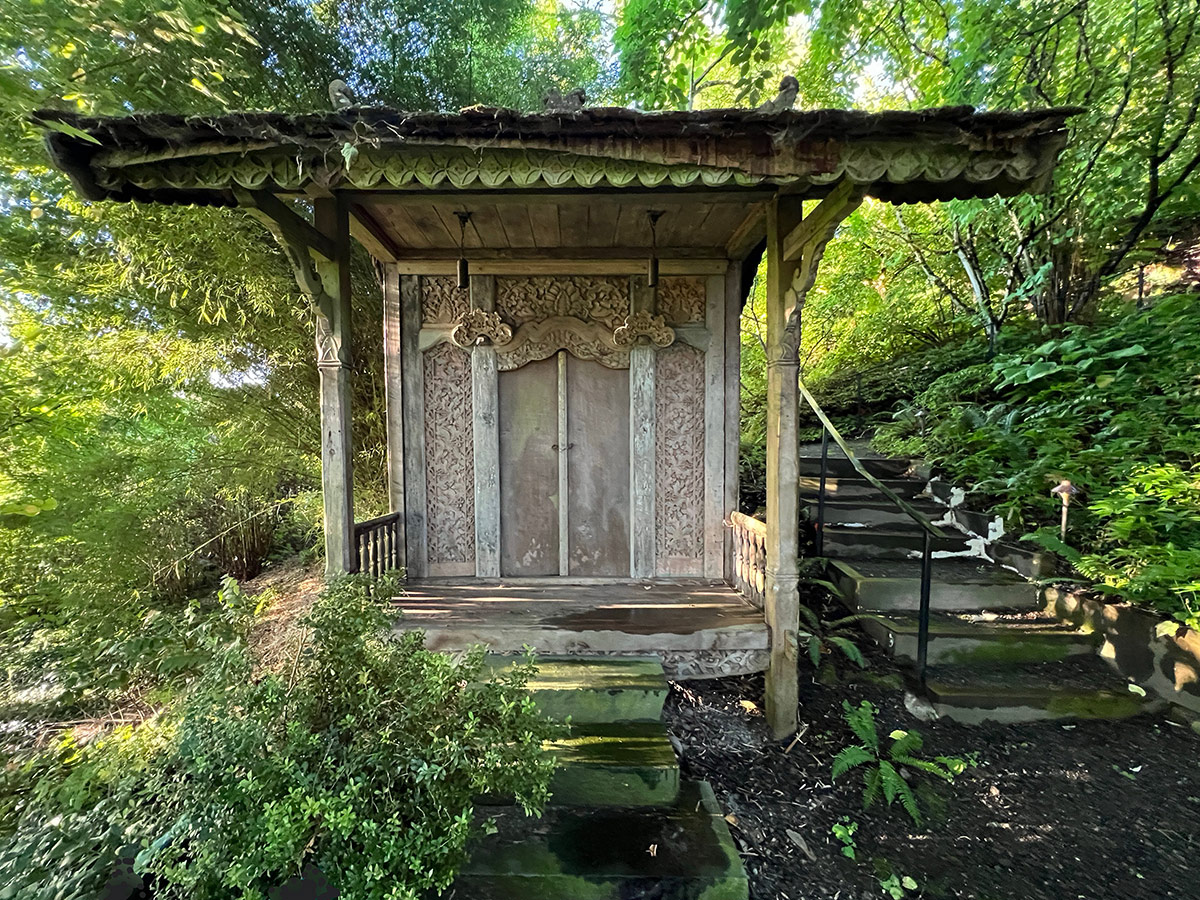
Continuing along the path, a small teahouse is tucked into the woods. Originally envisioned as a meditation space for Rekha, it also fulfills her childhood dream of having a treehouse. Today, it serves as a place where Rekha and her grandson have created new memories together. Positioned at the farthest point from the house, it offers deep immersion in nature—a space for rest, reflection, and renewal.
A visual experience that connects us to our inner world
The mature trees planted years ago now envelop the garden, providing privacy and a sense of seclusion. The addition of bold, tropical-style plantings enhances the feeling of being transported elsewhere. Together, all these elements create an environment that encourages disconnection from the outside world and reconnection with what matters most.
Ultimately, it is the people, places, and memories that shape our identity and give us a sense of home. Remembering is both a visual and emotional act—one that reconnects us to ourselves. A thoughtfully designed garden can hold those memories, allowing us to revisit them, reflect on them, and carry them forward.
More garden inspiration from Lisa:
Discuss this article or ask gardening questions with a regional gardening expert on the Gardening Answers forum.
And for more Pacific Northwest regional reports, click here.
Lisa Bauer is the owner of Chartreuse Landscape Design in Seattle.
Photos, except where noted: Lisa Bauer
Fine Gardening Recommended Products
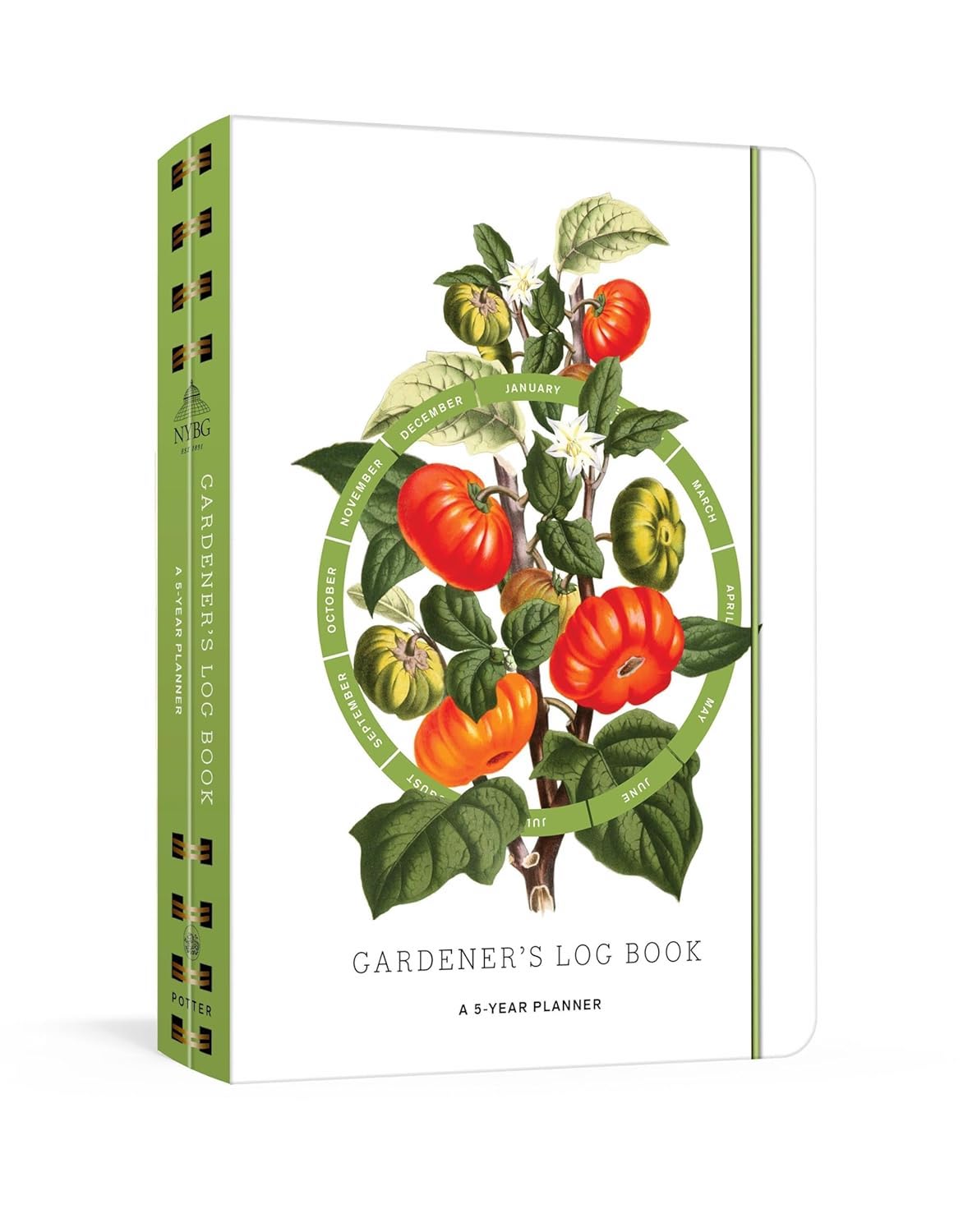
Gardener’s Log Book from NYBG
Fine Gardening receives a commission for items purchased through links on this site, including Amazon Associates and other affiliate advertising programs.
This weatherproof five-year log book includes the following features:
· Sturdy waterproof cover to protect pages from rain and muddy soil
· Lined pages and gridded paper for plotting beds
· Five years of 12-month bloom and harvest grids for recording what you planted and when
· Authoritative appendices on composting, pruning, pest and disease control, and container gardening
· Useful reminders by season on fertilizing, mulching, and transplanting
· Space for listing your favorite sources and suppliers.

ARS Telescoping Long Reach Pruner
Fine Gardening receives a commission for items purchased through links on this site, including Amazon Associates and other affiliate advertising programs.
Telescopes from 4 to 7′. Cut and Hold (160) Blades. Drop forged blades for unsurpassed long lasting sharpness. Lightweight, 2.3 lbs., for continued use. Perfectly balanced for easy pruning.

Ho-Mi Digger – Korean Triangle Blade
Fine Gardening receives a commission for items purchased through links on this site, including Amazon Associates and other affiliate advertising programs.
Versatile Tool: The Easy Digger Korean Triangle Blade Ho Mi Ho-mi is a versatile gardening tool designed for leveling and digging in home and garden settings. Efficient Design: Its unique triangular blade shape allows for easy soil penetration and efficient leveling of garden beds or landscaping areas. Durable Construction: Crafted with sturdy materials, this tool ensures long-lasting performance and reliability.
Ergonomic Handle: The comfortable handle provides a secure grip, reducing hand fatigue during extended use. Compact Size: Its compact design makes it easy to maneuver in tight spaces and store when not in use.