


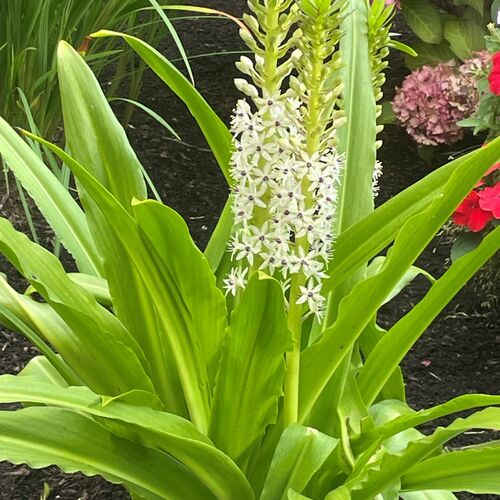
Today we’re returning to the garden of longtime GPOD contributor Lila in Mill Creek, Washington. We recently visited during her garden’s big community tour, and she’s back with another look at what’s thriving in August.
We’ve calmed down from our hectic but delightful garden tour experience, and now we can simply relax and enjoy our August garden as we celebrate our 60th wedding anniversary on August 27—as well as our daughter’s 55th birthday. A double celebration!
I’m thrilled that our ‘Sparkling Burgundy’ pineapple lily (Eucomis comosa ‘Sparkling Burgundy’, Zones 6–9) is thriving in its fifth year in our garden. I was relatively new to this lovely perennial when I first discovered it, but I knew I had to have one after seeing it in a friend’s garden years ago. It has such a tropical vibe, which is somewhat unusual in a Pacific Northwest garden.
My criteria when choosing a planting spot were simple: lots of sun, but I also had to be able to see it from our main patio and from inside our house. I hoped we had found the perfect place.
I purchased this beauty from my local nursery in May 2022, and she has been thriving ever since. We have a rabbit problem, so we protected our pineapple lily almost year-round with green fencing. This spring, we decided to risk it and removed the fencing in June—and apparently pineapple lily was not on the rabbit buffet menu!
I’m happy to see how much the pineapple lily has multiplied, and now I’m pondering if—and when—I should divide it. Help?
Enjoy the photos of this amazing pineapple lily!
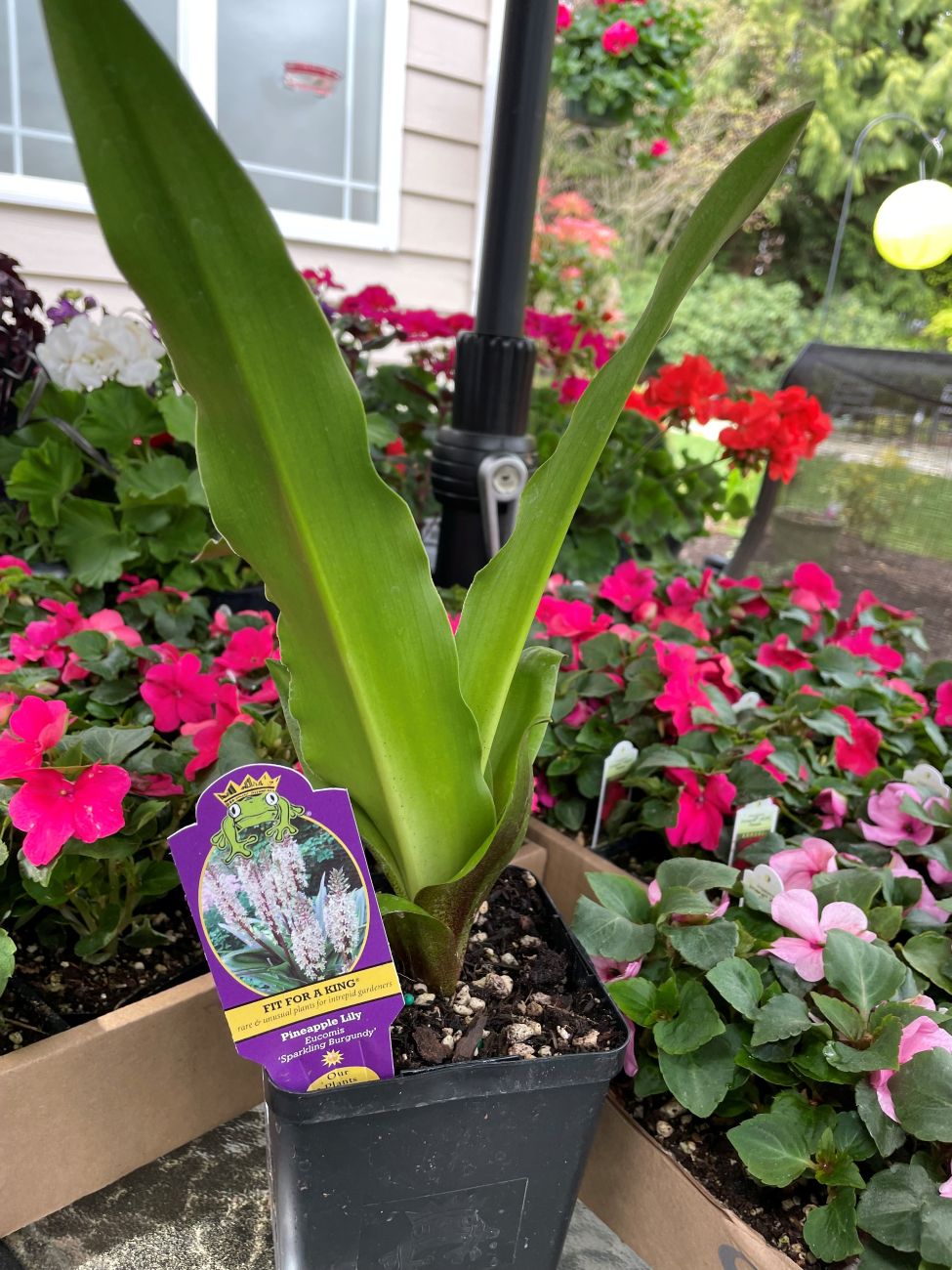
Waiting to be planted in May 2022, the pineapple lily was still a small nursery plant.
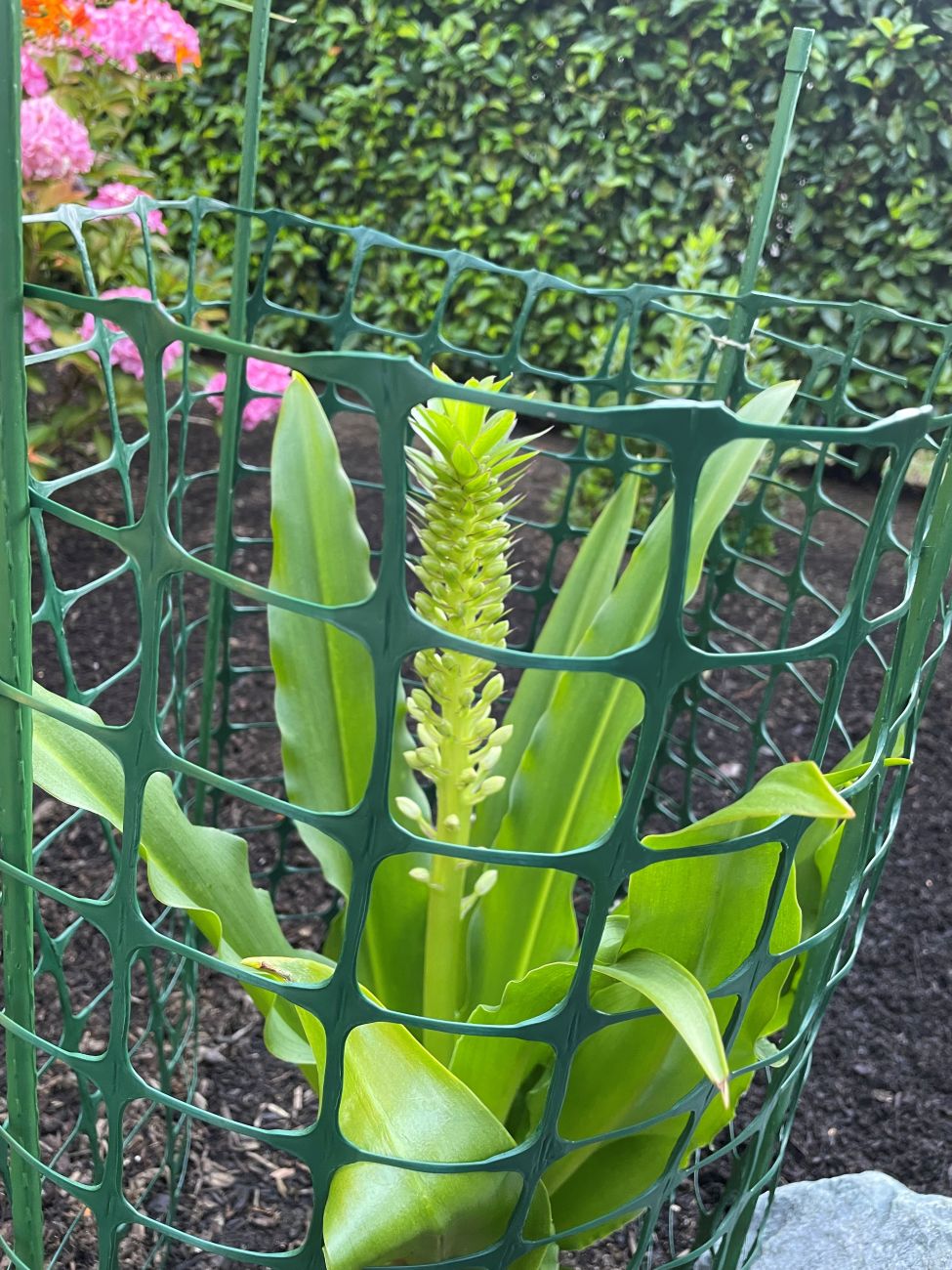
Green fencing surrounded the pineapple lily in August 2023, helping protect it from the rabbits that frequent Lila and Dave’s garden.
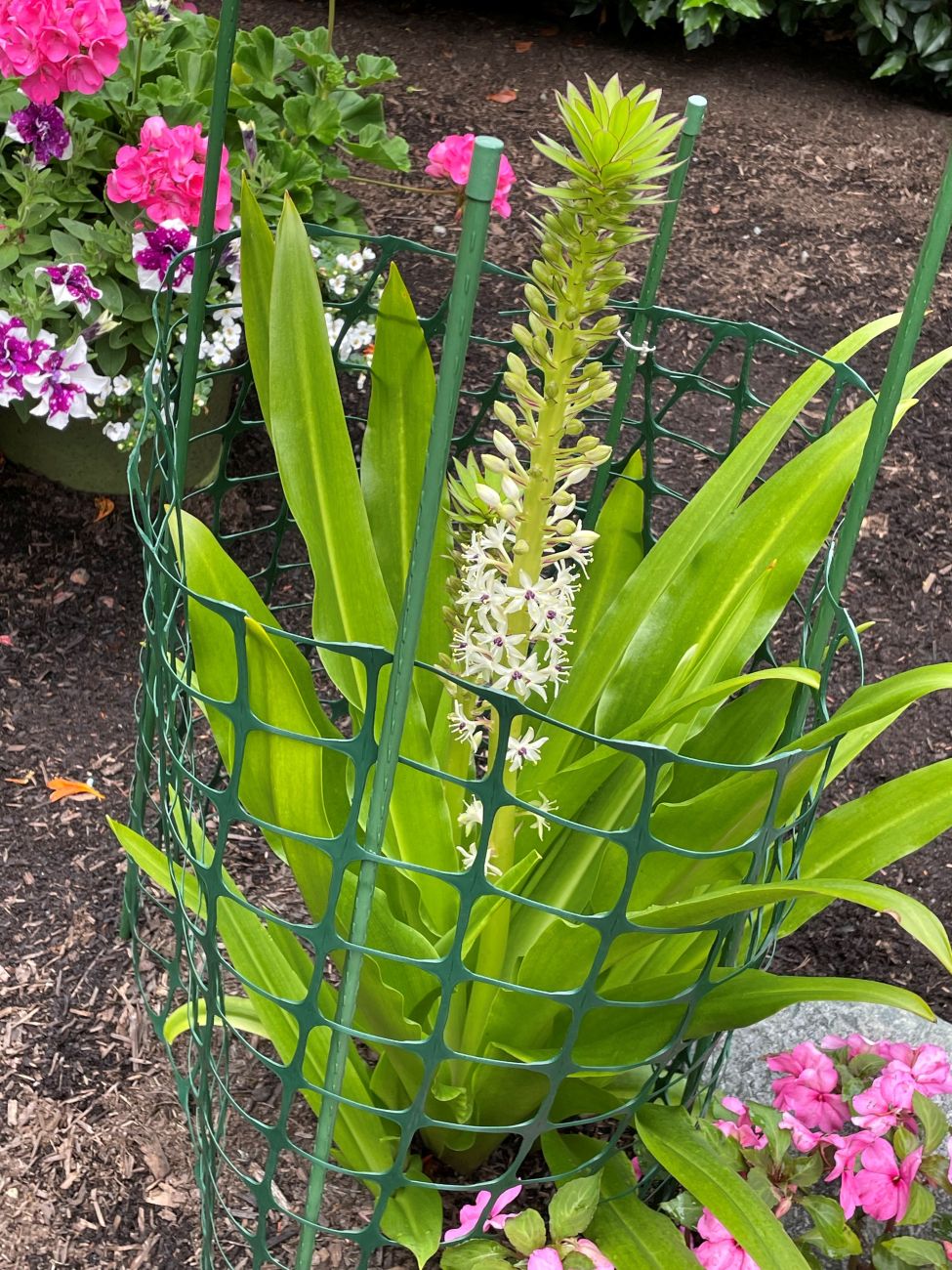
One substantial flower spike became the star of the show in August 2024, topped with the leafy crown that gives pineapple lily its common name.
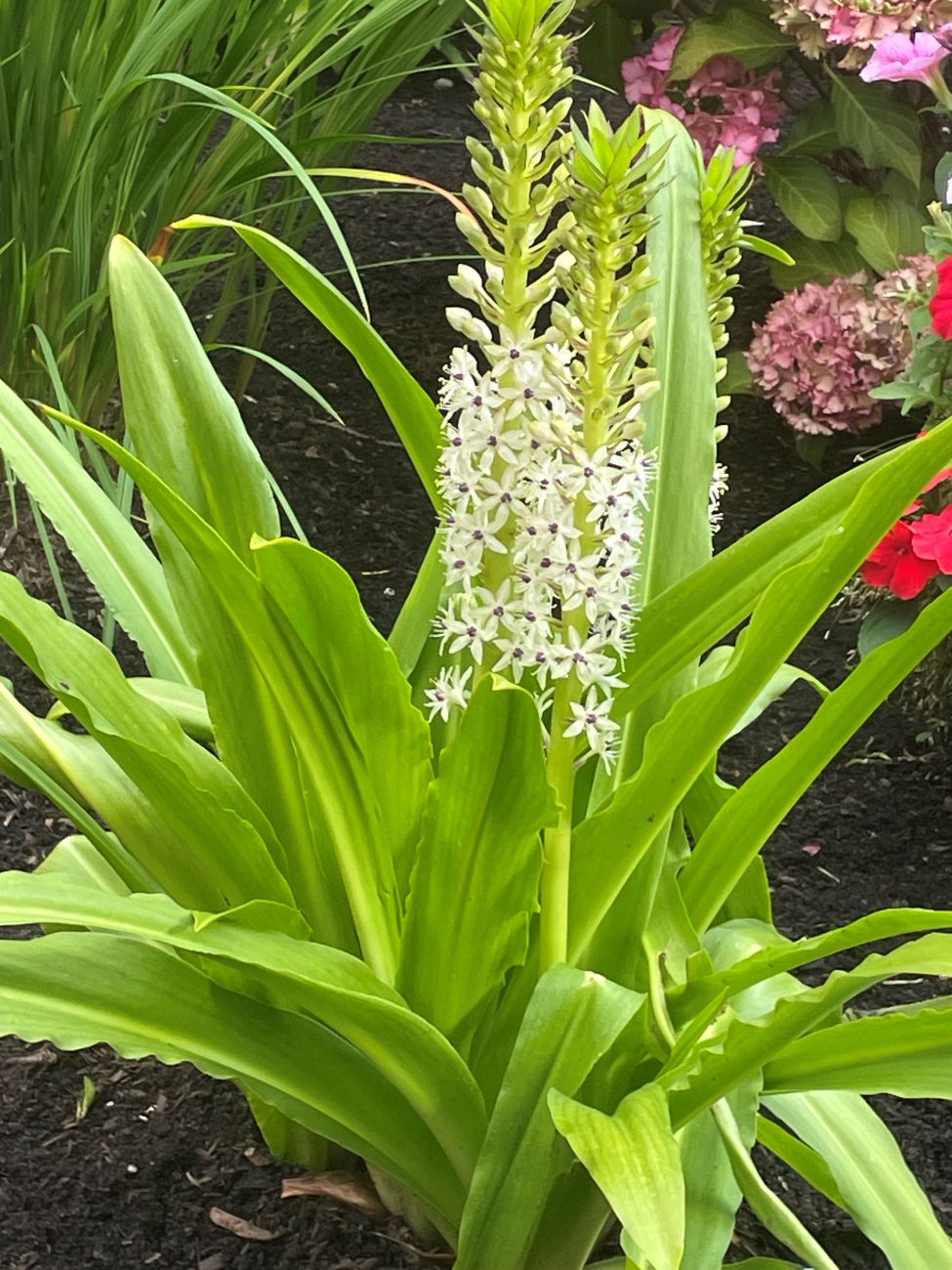
More flower stalks appeared by August 2025 as the pineapple lily continued to establish in the garden.
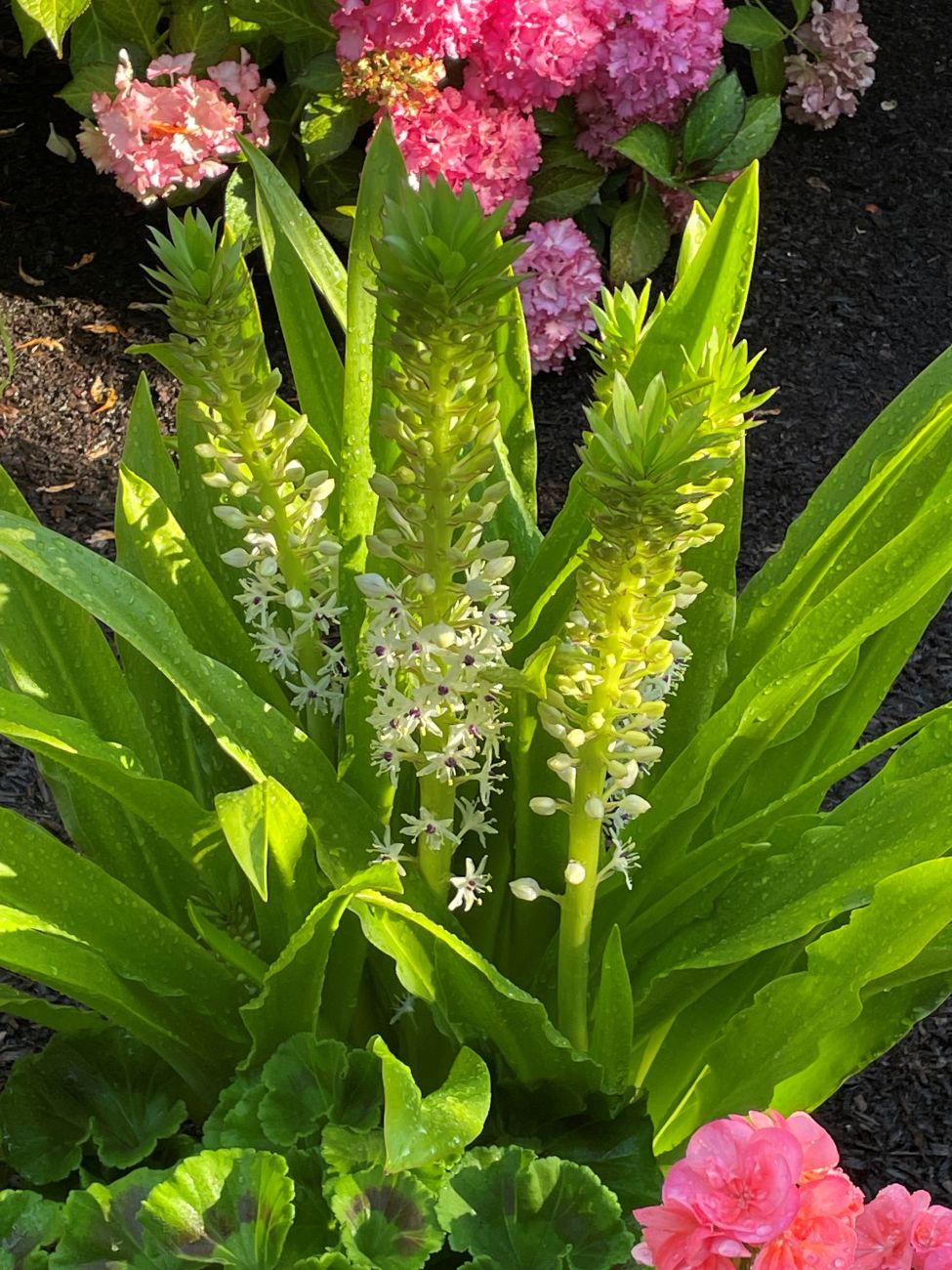
This year Lila and Dave took a chance and removed the rabbit fencing in June. By late August, the mature pineapple lily was still thriving without protection.
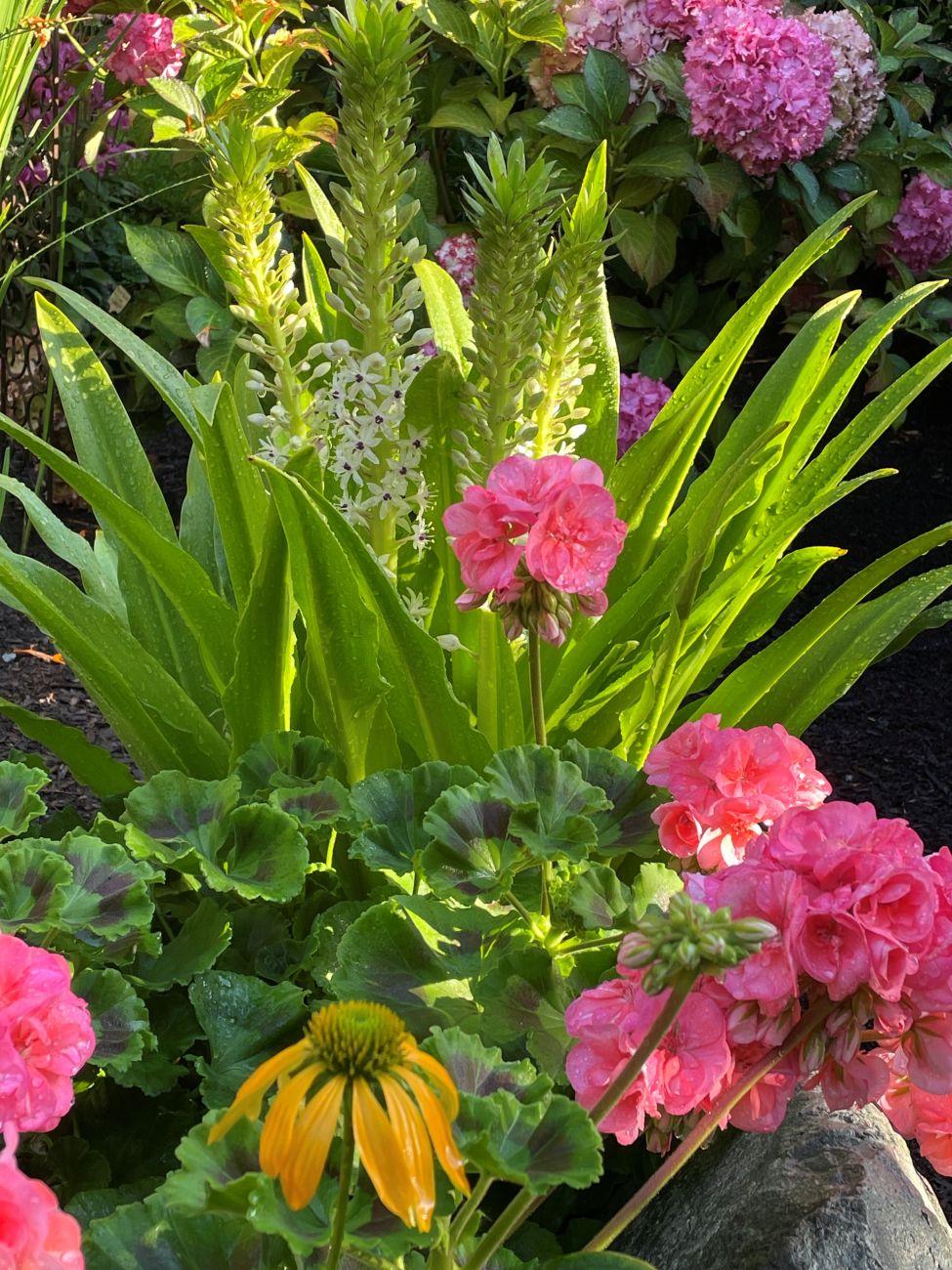
The pineapple lily makes a striking combination with coneflower (Echinacea hybrid, Zones 4–9), zonal geranium (Pelargonium × hortorum, annual), and bigleaf hydrangea (Hydrangea macrophylla, Zones 5–9).
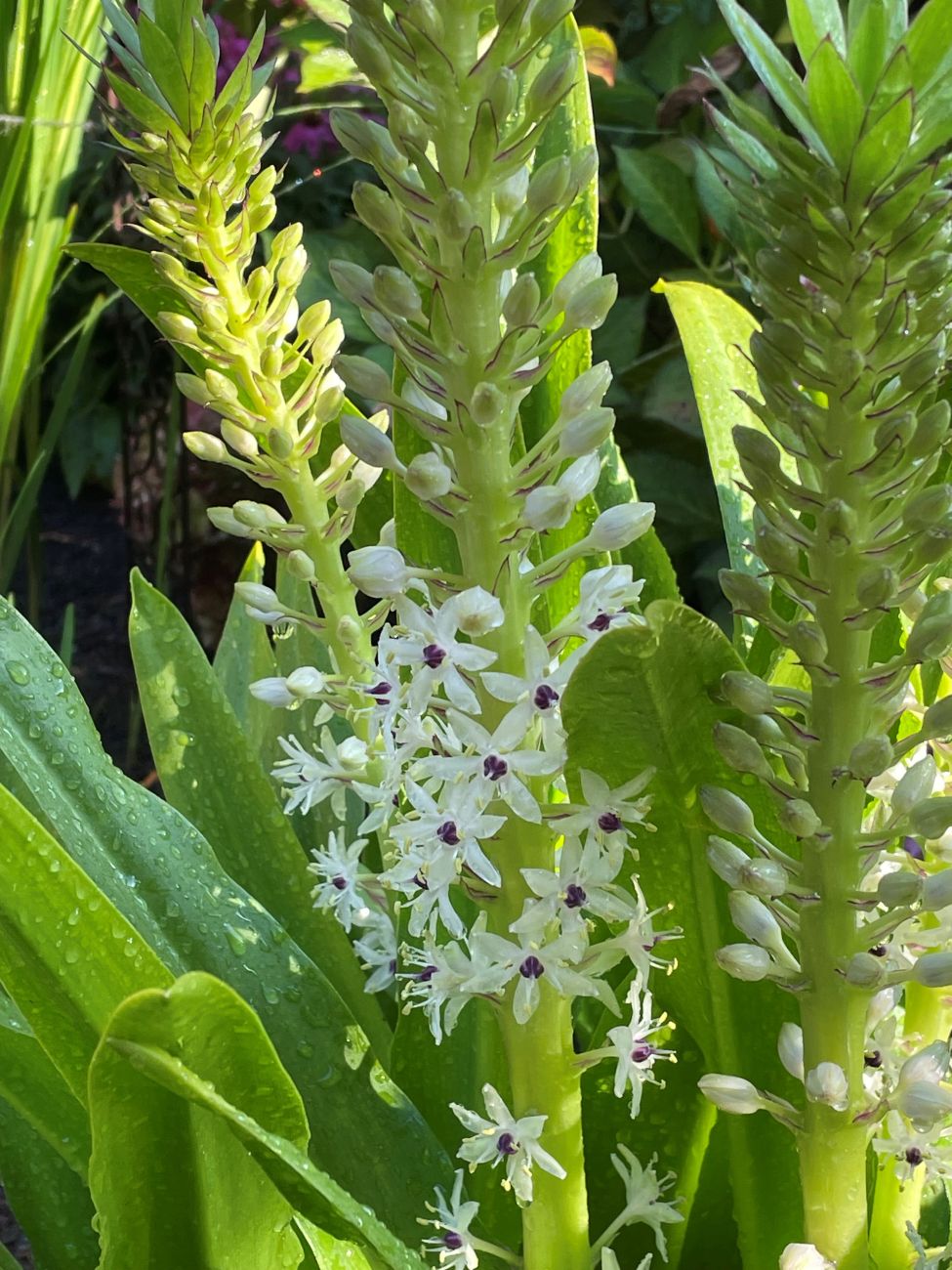
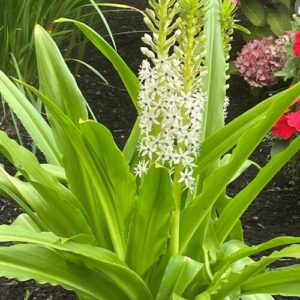
A closer look shows the pineapple lily’s dense cylindrical raceme, made up of dozens of small, six-petaled, star-shaped flowers. The blooms open from the bottom of the flower spike upward, while a tuft of leafy bracts at the top creates the plant’s characteristic pineapple-like appearance.
Lila asked if—and when—she should divide her impressive pineapple lily. Since the plant is flowering beautifully, there’s no rush to disturb this happy clump. But if she wants to make more plants or eventually reduce its size, pineapple lilies naturally produce bulb offsets that can be separated and replanted in spring.
Thank you for another wonderful garden update, Lila, and happy 60th anniversary to you and Dave!
We want to see YOUR garden!
Have photos to share? We’d love to see your garden, a particular collection of plants you love, or a wonderful garden you had the chance to visit!
To submit, fill out the Garden Photo of the Day Submission Form.
You can also send 5–10 photos to [email protected] along with some information about the plants in the pictures and where you took the photos. We’d love to hear where you are located, how long you’ve been gardening, successes you are proud of, failures you learned from, hopes for the future, favorite plants, or funny stories from your garden.
Do you receive the GPOD by email yet? Sign up here
Fine Gardening Recommended Products
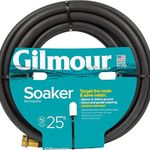
Gilmour 5/8″ x 25′ Round Weeper Soaker Hose
Fine Gardening receives a commission for items purchased through links on this site, including Amazon Associates and other affiliate advertising programs.
Lightweight garden hose is made of 100% recycled vinyl for clog resistant, consistent soaking in the garden or around foundations. Can be installed above or below ground to efficiently deliver water directly to plant roots. Can be linked with other hoses to create your own DIY garden drip irrigation system, and is flexible for easy storage and space saving.

Lee Valley Mini Garden Shear Set
Fine Gardening receives a commission for items purchased through links on this site, including Amazon Associates and other affiliate advertising programs.
These shears have a distinctive finger rest that not only aids grip but allows greater freedom of movement than a conventional handle design. They have a durable powder-coat finish to resist rust and wear, and a simple clasp that locks the spring-action stainless-steel blades closed. The set includes one pair of round-nose shears measuring 5 1/2″ overall with 1″ blades for cutting stems up to 3/8″ in diameter, and one pair of 6 1/2″ needle-nose shears with 2″ fine-tip blades for precise work.
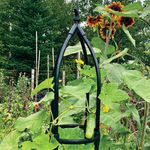
Lee Valley Garden Obelisks
Fine Gardening receives a commission for items purchased through links on this site, including Amazon Associates and other affiliate advertising programs.
Sturdy yet lightweight, these obelisks provide ample support for climbing plants while being easy to install and move. The medium obelisk stands 68 1/2″ high overall with a diameter of about 9 1/2″, compact enough for smaller containers indoors or out. The large size stands 86 1/2″ high with a diameter of 15 3/4″, ideal for larger outdoor spaces and containers.