

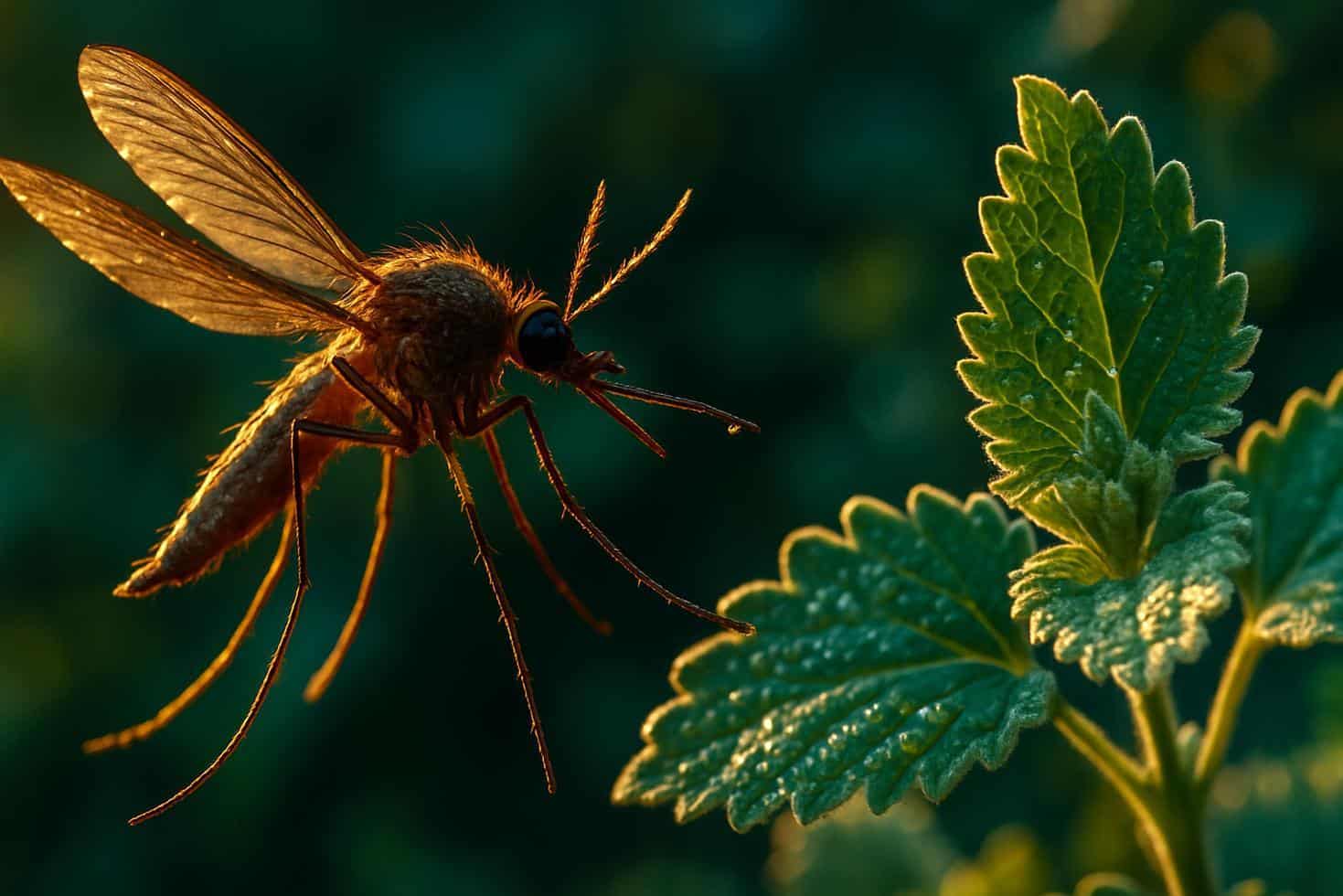
Catnip’s nepetalactone kept 75–80% of mosquitoes off a treated surface — DEET at the same dose kept away only 55–60%. That’s not a rounding error. That’s a different category of repellency.
Catnip’s nepetalactone repels mosquitoes more effectively than DEET by dose in laboratory spatial repellency tests. Iowa State University researchers placed groups of 20 mosquitoes in two-foot glass tubes and watched where they chose to go. The results surprised even the researchers running the study.
At just 0.1% concentration, nepetalactone kept roughly 75% of mosquitoes off the treated side of the tube. DEET at a comparable dose left 40–45% of mosquitoes still on the treated side. The gap is real, measured, and replicable under controlled conditions.
What Iowa State’s Glass-Tube Bioassay Actually Measured
The test was elegantly simple. A two-foot glass tube, split in half — one side treated, one side untreated. Twenty mosquitoes, 10 minutes, then a count.
At a 1.0% dose of nepetalactone, only about 20% of mosquitoes stayed on the treated side. At 0.1%, that number rose slightly to 25%. DEET at similar concentrations left 8 to 9 of every 20 mosquitoes still on the treated side. Peterson et al. calculated nepetalactone required roughly one-tenth the dose of DEET to achieve the same spatial repellency threshold.
How Nepetalactone Works as a Mosquito Repellent
Nepetalactone belongs to a class of compounds called iridoid monoterpenes. It doesn’t poison mosquitoes or physically block them. It functions through spatial repellency — mosquitoes detect it and move away from the zone where it’s present.
One hypothesis is that nepetalactone structurally resembles certain insect alarm compounds, triggering an avoidance response through the mosquito’s chemical sensing system. The compound works as a spatial signal, not a contact barrier. Mosquitoes never need to land to be repelled.
Why the Cat Response and the Mosquito Response Are Unrelated
Cats roll in catnip because nepetalactone binds to feline olfactory receptors and triggers a neurological response that researchers still don’t fully understand. It’s a side effect, not the plant’s strategy.
The mosquito-repellent activity is the more ecologically grounded relationship. Plants in the Nepeta genus produce these iridoids through their essential oil glands. The compound requires extraction or distillation to be active at repellent concentrations — a cat rolling on a plant doesn’t release nearly enough.
The compound sending cats into a frenzy is, by dose efficiency, a stronger mosquito repellent than the gold-standard synthetic chemical developed for exactly that purpose.
Frequently Asked Questions
Is catnip a proven mosquito repellent?
Iowa State University laboratory testing confirmed nepetalactone from catnip essential oil outperformed DEET in spatial repellency at comparable doses.
Does rubbing catnip on skin repel mosquitoes?
The active compound comes from the plant’s essential oil. Mechanical crushing of fresh leaves releases far lower concentrations than distilled oil.
How does nepetalactone repel mosquitoes without killing them?
It functions through spatial repellency — mosquitoes detect the compound and avoid the treated area rather than making contact with it.
Is nepetalactone safe for humans?
The Iowa State research focused on efficacy, not human safety testing. Nepetalactone’s safety profile for topical use was not confirmed in that study.