

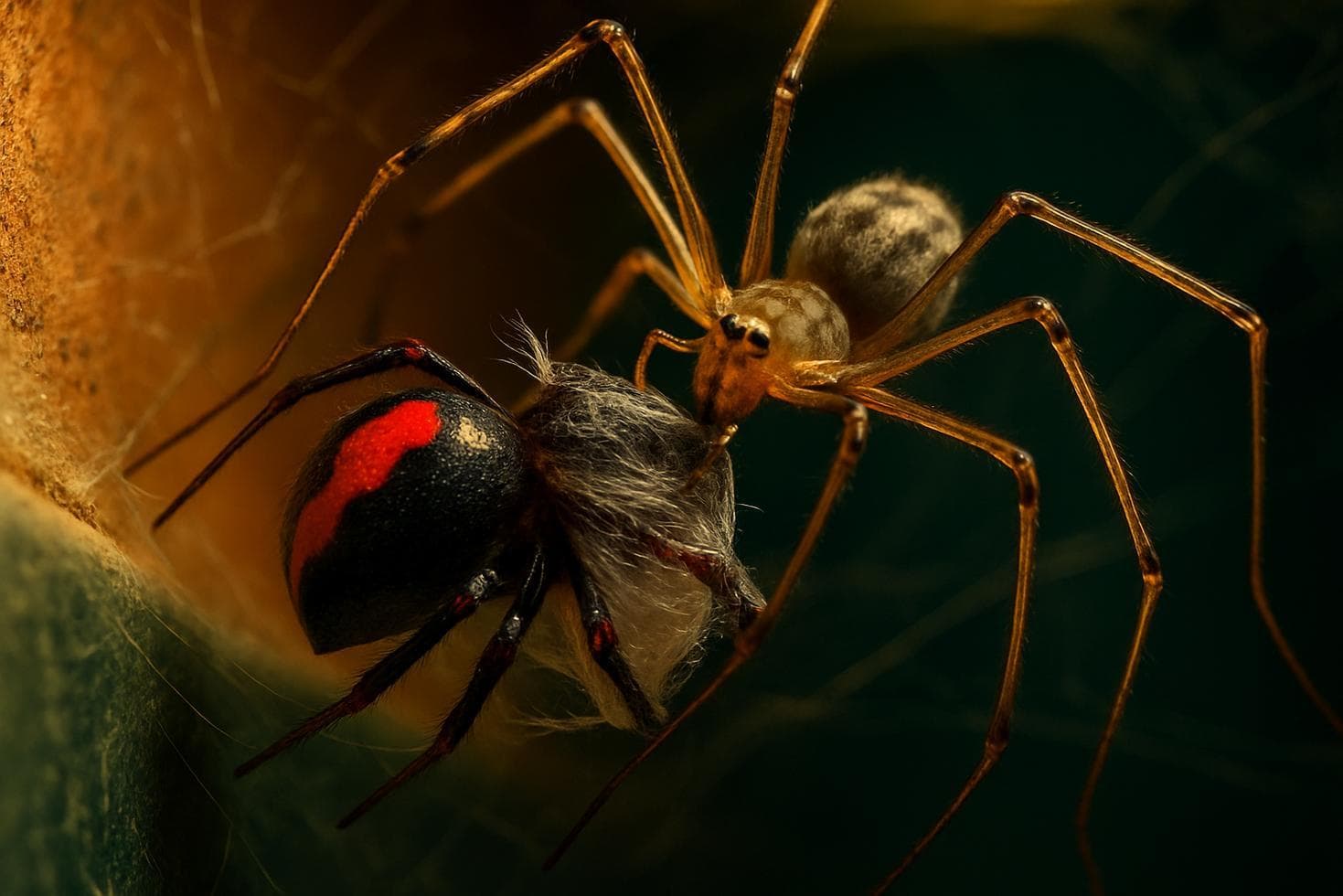
0.25 mm fangs — the same size as a brown recluse’s — and a cellar spider uses them to take down redbacks, black widows, and brown widows. The weapon was never the venom.
Cellar spiders do kill venomous spiders, including redbacks, black widows, and brown widows, and they do it through predation mechanics rather than any exceptional toxin. The long-legged ghost haunting garage corners has been watched dispatching prey far more dangerous to humans than itself — which is exactly where the legend went sideways.
The popular myth concludes that if something kills a black widow, it must be secretly the most venomous creature alive. Researchers at UC Riverside and the Burke Museum have both documented the opposite: cellar spider venom is not considered especially dangerous to people, and no published study has demonstrated a toxic effect in humans.
How Cellar Spiders Actually Subdue Dangerous Prey
Speed and silk are doing the real work. When a venomous spider enters a cellar spider’s web, the cellar spider flings silk faster than the prey can orient and respond. The target gets wrapped before landing a bite.
Once immobilized, the cellar spider bites through the silk and delivers venom to finish the job. Silk wrapping before the killing bite is the sequence that makes this work — the venom doesn’t need to be extraordinary if the prey is already immobilized.
Those fangs measure just 0.25 mm, comparable in size to a brown recluse’s fangs according to the Australian Museum. Small, but sufficient.
The Myth That Got the Story Backwards
People observed cellar spiders killing redbacks and made a logical-sounding leap: something that kills a venomous spider must carry stronger venom. The Burke Museum and UC Riverside have both specifically addressed this, noting there is no scientific evidence that cellar spider venom is harmful to humans at all.
Cellar spiders can bite humans, and the Australian Museum notes the result is a short-lived burning or stinging sensation. Rare cases may last longer. That’s the documented human experience — not a hidden super-toxin waiting to be discovered.
Quick Answer
- Cellar spiders prey on redbacks, black widows, and brown widows using silk-wrapping, not superior venom.
- Their fangs measure 0.25 mm — similar to a brown recluse’s — and can pierce human skin.
- A bite on humans typically causes brief burning or stinging; no published study shows toxic effects in humans.
- The “most venomous creature alive” claim has no scientific support and has been directly rebutted by multiple research institutions.
The real story is a predator that solved a geometry problem: wrap first, bite second, and the size of the prey stops mattering. Forty years of watching spiders, and this one still earns a second look every time it appears in a corner.
The fangs were never the most dangerous thing about it. The silk was.
Frequently Asked Questions
Are cellar spiders actually the most venomous spiders in the world?
No. The Burke Museum and UC Riverside both state there is no scientific evidence for this claim. Their venom is not considered dangerous to humans.
Can a cellar spider bite a human?
Yes. The fangs, at 0.25 mm, can pierce human skin. The Australian Museum describes the result as a short-lived burning or stinging sensation.
How does a cellar spider kill a redback or black widow?
It flings silk to wrap and immobilize the prey before biting, relying on speed and restraint rather than venom potency.
Are cellar spiders and daddy longlegs the same thing?
No. True daddy longlegs (harvestmen) are not spiders, have no venom glands, and cannot inject toxins. Cellar spiders are true spiders and a completely different animal.