

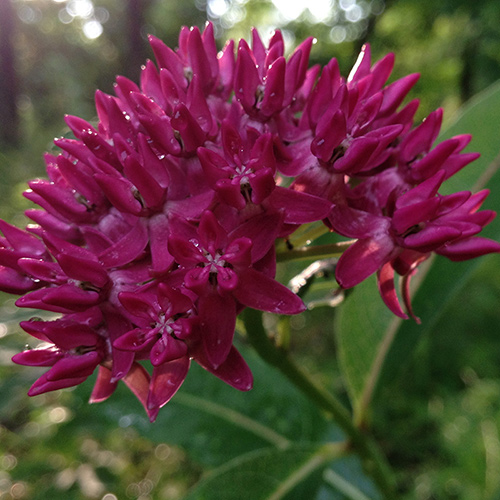
Monarchs and their fluctuating populations have certainly captivated the attention of gardeners and the general public over the last couple of decades. Challenges for the monarch have included loss of habitat, extreme weather and climate fluctuations, and pesticide use. We associate the many species of milkweeds (Asclepias sp.) with their availability in positively supporting the life cycle of this popular butterfly along with many other pollinators. While all milkweeds deserve attention, this article highlights purple milkweed (Asclepias purpurascens, Zones 3–8). This species is listed as endangered in my home state of Wisconsin and is one of many examples of endangered or threatened species that deserve recognition, protection, and perhaps more direct reestablishment efforts. Coincidentally, the Wisconsin Department of Natural Resources (DNR) has announced milkweed as the Rare Plant Monitoring Program’s 2025 Plant of the Year and encourages planting milkweed to help monarchs.

While laws and policies may differ between states, most include some form of classification for plants (and animals) that would qualify as endangered, threatened, imperiled, or of special concern. Broadly defined, the endangered classification is applied to a species whose continued existence as a viable component of the ecosystem is determined to be in jeopardy based on scientific evidence. The purple milkweed is endangered in both Wisconsin and Massachusetts. Additionally, it is considered imperiled in Maryland and of special concern in Connecticut and Tennessee.
Natural habitat and preferred growing conditions for purple milkweed
This milkweed is found in open oak forests, in forest margins, and along roadsides. It has a broad native range but has become less common and, in some cases, rare, due to the loss of oak savanna ecosystems. Of the 13 native milkweed species in Wisconsin, 5 are listed as endangered, threatened, or of special concern. Purple milkweed is particularly threatened as it is more sensitive to the environment and a bit more finicky than other milkweeds. It requires consistent moisture and is generally less drought tolerant; it also has a slower maturation rate with about two to three years needed to flower after establishment. Hardy from Zones 3 to 8, this species prefers part shade but will tolerate full sun if deep, regular watering is provided.

I’ve grown this colorful and compact species and enjoy the beautiful, rounded (2- to 3-inch) umbels that display showy red-purple flowers from early June through July. The blooms are sweetly fragrant and extend farther from the foliage than common milkweed (Asclepias syriaca, Zones 3–9). This erect perennial grows to about 36 inches in height and typically features a primary terminal flower on the central stem with occasional side flowers. The flowers are stiff and hold their rounded form well. This species is considerably less aggressive than common milkweed and is an amazing host plant. In tandem with other milkweed species, purple milkweed is rarely browsed by herbivores because of the bitter-tasting, toxic foliage and is black walnut tolerant.

Spread information to increase protections
The purple milkweed, while just one local example in my home state of Wisconsin, represents a category of plants that requires more awareness and appreciation of their history, challenges, and importance in our natural areas. This awareness of impacted plant populations, in all our states and regions, allows us to further promote the protection and perhaps additional restoration, planting, and care of these plants.

More helpful resources on endangered plants:
Discuss this article or ask gardening questions with a regional gardening expert on the Gardening Answers forum.
And for more Midwest regional reports, click here.
Mark Dwyer is the garden manager for the Edgerton Hospital Healing Garden in Edgerton, Wisconsin, and he operates Landscape Prescriptions by MD.
Fine Gardening Recommended Products
D&X Garden Sprinkler
Fine Gardening receives a commission for items purchased through links on this site, including Amazon Associates and other affiliate advertising programs.
– The Sprinkler is made of durable ABS Plastic, Base connector: Approx. 1/2″ ; Side connector: Approx. 3/4″
– 12 flexible nozzles that you can set in any direction, simply bend hoses to customize new watering patterns
– 360 degree coverage of 3000 sq. ft area
– 3.5 x 4 x 6 inches

National Wildlife Federation®: Attracting Birds, Butterflies, and Other Backyard Wildlife, Expanded Second Edition (Creative Homeowner) 17 Projects & Step-by-Step Instructions to Give Back to Nature
Fine Gardening receives a commission for items purchased through links on this site, including Amazon Associates and other affiliate advertising programs.
From the National Wildlife Federation, the largest U.S. nonprofit conservation organization, with 6 million members and 51 state and territorial affiliated organizations. 17 step-by-step projects that everyone can do together make getting your family back to nature easy, educational, and fun. Over 200 color photos of backyard wildlife habitats and the wide variety of creatures they attract, plus step-by-step photos and illustrations for family projects. Learn wildlife-friendly practices for gardening, landscape design, supplemental feeders, birdbaths, nesting places, and more. Learn how to attract backyard pollinators, from bees and butterflies to beetles, bats, and hummingbirds
Get your garden certified by the National Wildlife Federation’s Garden for Wildlife(TM) program by following the included certification application checklist.
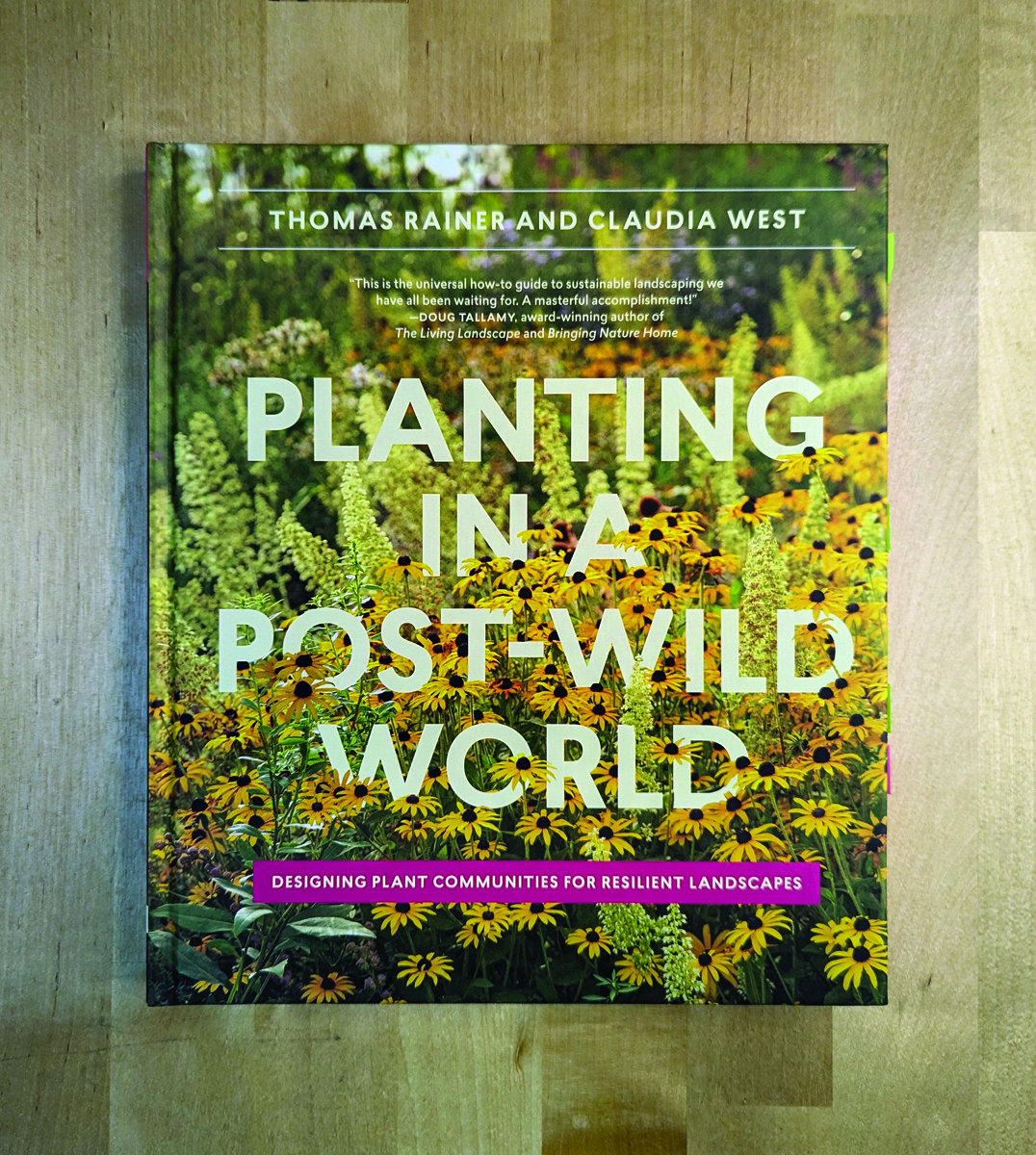
Planting in a Post-Wild World: Designing Plant Communities for Resilient Landscapes
Fine Gardening receives a commission for items purchased through links on this site, including Amazon Associates and other affiliate advertising programs.
Featuring gorgeous photography and advice for landscapers, Planting in a Post-Wild World by Thomas Rainer and Claudia West is dedicated to the idea of a new nature—a hybrid of both the wild and the cultivated—that can nourish in our cities and suburbs.