


Yves here. Readers may choose to dismiss this new version of a good old fashioned containment strategy, now attempted by the US in Eurasia, as doomed to fail. But even if it logically is, given the massive productive capacity of China and the arms prowess and natural resources wealth of Russia alone, the future might take longeer to arrive than anti-globalists might hope.
First, the US is vastly more willing to engage in violence to preserve its pretenses to global dominance than China and Russia are. While in the longer run this will be self-defeating (we can see how militarization and sanctions policies are already reducing living standards and increasing social and political fractures in Europe), it might have a measure of success as a costly delaying tactic (if the US and Europe had more managerial/execution competence, the odds would be a lot better).
Second, this article focuses on the biggest players in Eurasia, and touts, as Russia has taken to doing of late, the stature of “civilizational states”. That might sound wonderful to US oppoents reclaiming their mantles as Great Powers. But now that I live in Southeast Asia, it highlights new bossdom versus old bossdum.
Smaller countries of necessity usually get to be pretty good at playing bigger ones off against each other. Even with the compartively short time I have been in Thailand, I can point to initiatives the government is taking to placate each of China and the US/OECD. One indicator of the reservations, at least in this part of the world, about jumping enthusiastically on the China-Russia led BRICS/new world order bandwagon is the limited participation from this region in the recent Minsk International Conference on Eurasian Security, meant to be an altertive to the Munich Security Conference (see Karl Sanchez for details). Laos, Malaysia, Singapore and Thailand did not send representatives.
We reported on doubts about aspirations versus emerging realities of the new multipolar order in “BRICS Are the New Defenders of Free Trade, the WTO, the IMF and the World Bank” and Supporting Genocide by Continuing to Trade with Israel. A key section:
Vanessa Beeley (32:18): And as we keep saying, if you’re going to hold BRICS countries up, Russia and China up, as some kind of viable alternative to the paradigm we’ve been living in for decades and that the world is sick of, then how can we accept that they’re doing virtually the same thing?…
Fiorella Isabel (38:40): It is actually just a very formulaic type of, of cheerleading for a team. It’s just more iterations of that, you know, from the microscopic left, right paradigm to, you know, multipolar and unipolar thing. It’s become just very much iterations of the same type of mentality where you’re just choosing a team and you’re just repeating what is most advantageous for you, what is most popular, what X, Y analysts said and whatever they say goes. And so when you question outside of that, you break people’s brains.
Hence it is rational for smaller fry to try to play both sides rather than make firm commitments.
By Andrew Korybko, a Moscow-based American political analyst who specializes in the global systemic transition to multipolarity in the New Cold War. He has a PhD from MGIMO, which is under the umbrella of the Russian Foreign Ministry. Originally published at his website
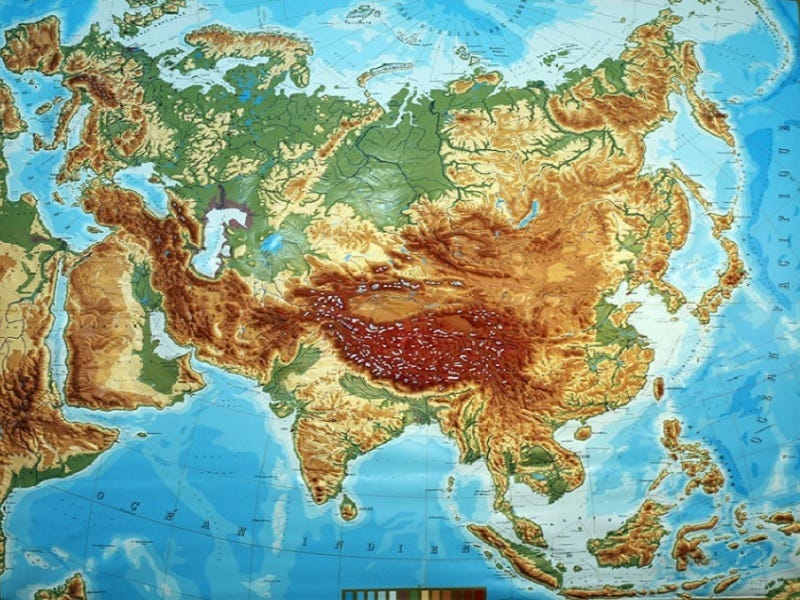
US-backed NATO, Pakistan, and the “Asian/Containment Crescent” of Japan, Taiwan, and the Philippines are poised to respectively face off against Russia, India, and China across this century.
The US is sending mixed signals about the Sino–Russo Entente, which was strengthened by the Power of Siberia 2 gas pipeline deal, after Trump said in September that he’s “not concerned” about it while Secretary of War Pete Hegseth claimed that he ordered him to “re-establish deterrence” against them. As was argued here, “Trump 2.0’s Eurasian Balancing Act Has Failed” largely as a result of this development, which importantly involved India’s tacit approval amidst its rapprochement with China.
Far from remaining divided, principally as regards China and India with all the complications that their continued rivalry would entail for Russia’s own balancing act, Eurasia’s three most powerful civilization-states are increasingly coming together to revive their dormant Russia-India-China (RIC) format. This platform is significant on its own but it’s also crucially the core of BRICS and the SCO, which play complementary roles in gradually transforming global governance as explained here.
These RIC-accelerated multipolar processes can’t be countered through direct military force, however, but the way in which the Pentagon might try to slow everything down is through provoking arms races. NATO’s, Pakistan’s, and the “Asian/Containment Crescent’s” (Japan-Taiwan-Philippines) US-backed military buildups (partial in Pakistan’s case) could help achieve this vis-à-vis Russia, India, and China as could reinforced US military presences (or a formal return in Pakistan’s case) in each.
Likewise, the “Golden Dome”, intermediate-range missile deployments in their regions, and more militarization of outer space can place additional pressure on Russia and China to this end, though these moves could also backfire by enhancing those two’s military-technical coordination too. To be clear, Russia and China aren’t allies that would go to war for one another, but their shared military-security and strategic interests raise the chances that they’ll provide support for the other during wartime.
China has thus far eschewed sending military-technical aid to Russia due to its complex interdependence with the West, but Trump’s tariff war, his accusation that President Xi Jinping is “conspiring” against the US, and the Pentagon’s plans for the “Asian/Containment Crescent” might prompt a recalculation. In a similar spirit, Russia might become comfortable sharing cutting-edge military-technical knowledgewith China to counterbalance US moves in Japan, which could extend to their shared North Korean ally too.
Although the lion’s share of Pakistan’s military-technical equipment comes from China, the US might break into this market if Chinese exports decrease due to the Sino-Indo rapprochement, which could also lead to a decrease in American exports to India and the need to replace them with exports to Pakistan. Russia might even regain its traditional role as India’s top supplier by far if exports to it spike in response to more US exports to Pakistan in a de facto revival of the region’s Old Cold War-era military dynamics.
All of these strategic dynamics set the stage for a security dilemma between the Eurasian Rimland (NATO, Pakistan, and the “Asian/Containment Crescent”) and the Eurasian Heartland (RIC) instigated by the US in order to “re-establish deterrence” vis-à-vis the Sino-Russo Entente. The purpose is to pressure one of them or their shared Indian partner into capitulating to the US so as to then more effectively divide-and-rule the supercontinent. This hegemonic plot will define Eurasia’s 21st-century geopolitics.